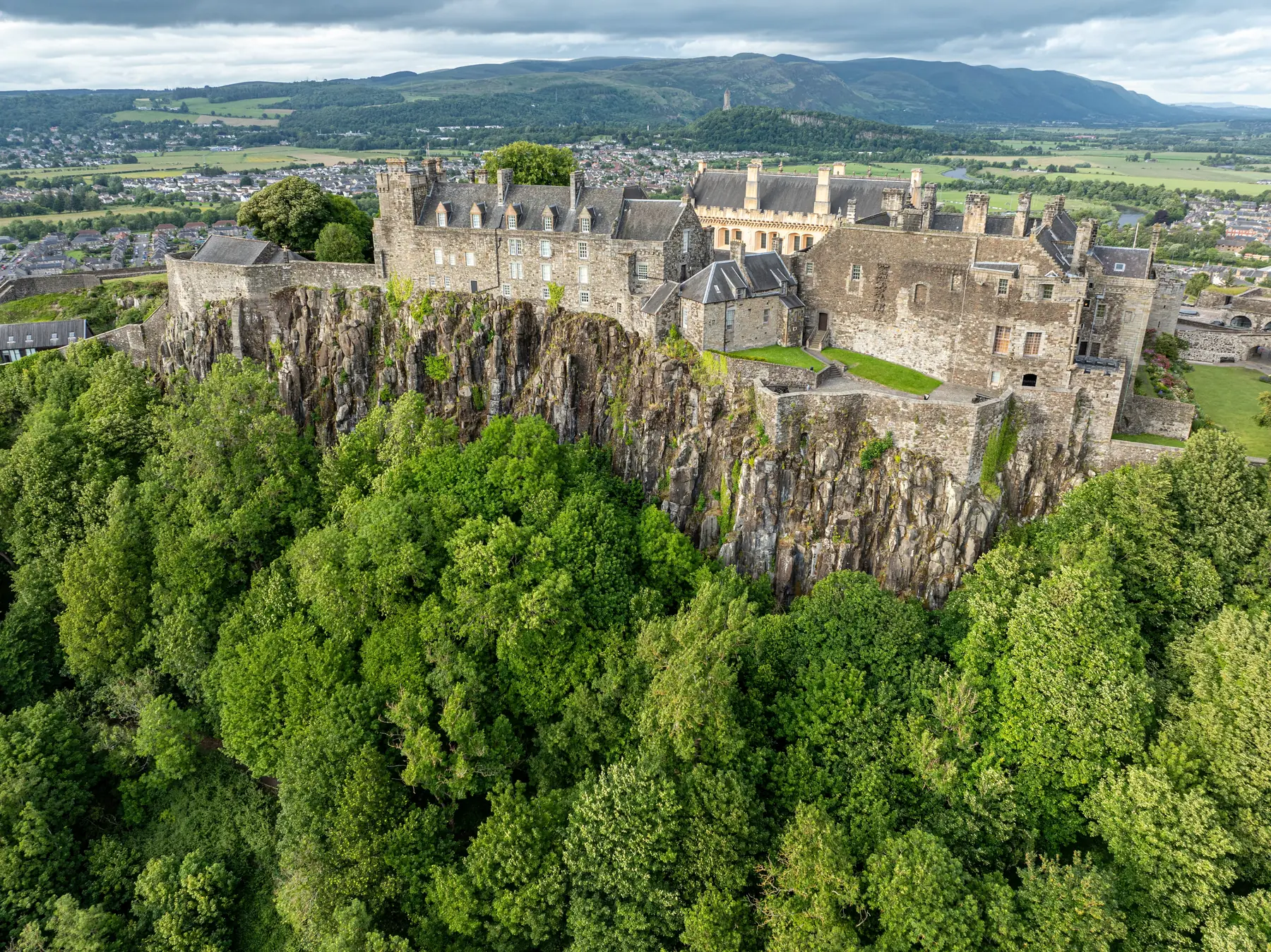
Stirling’s whole historical importance rests on where it is: the lowest bridging point of the Forth, the pinch between the Highlands and the Lowlands, and the crossroads of Scotland. “Stirling,” someone once wrote, “like a huge brooch clasps Highlands and Lowlands together.”
That makes it an exceptional base. Glasgow and Edinburgh are both under an hour. Loch Lomond and the Trossachs begin half an hour west. Perth and the road north are half an hour away. And the whole of central Scotland is within a ninety-minute radius.
Twenty-five kilometres north-west. Callander is the gateway town to the Loch Lomond and the Trossachs National Park, with the Bracklinn Falls and Callander Crags above it and the Rob Roy story attached to the whole district.
Beyond it: Loch Katrine, with the steamship Sir Walter Scott running on it and a traffic-free road round the shore for walking and cycling; Loch Achray and Loch Venachar; Aberfoyle and the Duke’s Pass; and Ben A’an, a small hill with a very large view that is the best short climb in the Trossachs.
Forty-five minutes west. The largest freshwater loch in Britain by area, with Balmaha and Luss on its shores, boat trips, and Conic Hill above Balmaha giving the classic view over the islands — which sit, as it happens, on the Highland Boundary Fault.
Ten kilometres north-west. Doune Castle, one of the most complete medieval castles in Scotland, on a wooded bend of the Teith — and the filming location for Monty Python and the Holy Grail, the Game of Thrones pilot and Outlander.
Blair Drummond Safari Park is on the same road.
Twenty minutes east, and an unexpectedly good day out.
The Kelpies — two thirty-metre steel horse heads standing beside the Forth and Clyde Canal in a public park. They are free, they are enormous, and they are among the most-visited attractions in Scotland.
The Falkirk Wheel — a rotating boat lift that raises canal boats twenty-four metres between the Forth and Clyde and Union canals, replacing a flight of eleven locks. You can ride it. It is the only rotating boat lift in the world.
Callendar House — a large mansion with a Georgian kitchen worked by costumed cooks, a museum and a park, and it is free.
Add the Antonine Wall, the Roman frontier that runs through Falkirk district and is a World Heritage Site, and it is a full day.
Dunblane, eight kilometres north, has a thirteenth-century cathedral that is one of the finest medieval churches in Scotland, free to enter, in a small and pleasant town.
Bridge of Allan, four kilometres north, is a Victorian spa town that is now largely the University of Stirling’s town.
Perth, half an hour north, has Scone Palace — where the kings of Scots were crowned on the Stone of Destiny — the Black Watch Museum, and the road on into Highland Perthshire.
Gleneagles and Auchterarder are on the way.
East of the city, the Ochil Hills rise abruptly from the plain, and the hillfoots villages — Menstrie, Alva, Tillicoultry, Dollar — sit along their foot, each with a glen cut into the escarpment behind it.
Dollar Glen is the best, climbing through a gorge to Castle Campbell, which stands on a spur between two ravines and is one of the most dramatically sited castles in Scotland.
Alloa, nine kilometres east, has Alloa Tower — the largest surviving medieval keep in Scotland — and a long brewing history.
Glasgow is fifty minutes by train: Kelvingrove, the Burrell Collection, the Mackintosh buildings and the best shopping in Scotland.
Edinburgh is fifty minutes the other way: the castle, the Old Town, the National Museum and the galleries.
Being able to do either as a comfortable day out, and to be back for dinner, is the single strongest argument for basing a Scottish trip in Stirling rather than in one of them.
Stirling is one of the best-connected towns in Scotland. The station is in the middle of the city, with frequent trains to Glasgow Queen Street and Edinburgh Waverley — both around fifty minutes — and north to Dunblane, Perth, Dundee and the Highland line to Aviemore and Inverness. Alloa is on a branch to the east.
Buses run west to Callander, Aberfoyle and the Trossachs, east to Falkirk and the Kelpies, and to the hillfoots villages and Doune.
The one gap is the deeper Trossachs and Loch Lomond’s eastern shore, where services thin considerably outside the summer. Our getting here page has more.
The Trossachs day. West to Callander for the morning, on to Loch Katrine for a sailing on the steamship or a walk along the traffic-free shore road, and back via Aberfoyle and the Duke’s Pass. Around ninety minutes of driving in total and the best scenery within an hour of the city.
The Falkirk day. East to the Kelpies first thing while the light is good, then the Falkirk Wheel for a boat trip, and Callendar House — which is free — in the afternoon. Twenty minutes each way and entirely doable by bus.
The castles day. Stirling Castle in the morning, Doune Castle at midday, and Castle Campbell above Dollar Glen in the afternoon — three castles, three centuries and one of the most dramatic castle settings in Scotland at the end of it.
Stirling sits on the M9 and the A9 and the roads out are good, which is unusual in Scotland. The constraint is the A84 and A821 into the Trossachs, which are narrow, busy in summer and slow behind caravans, and the Loch Lomond road, which queues on sunny weekends.
The trains are frequently the better option for Glasgow, Edinburgh and Perth, and the buses cover Falkirk and Callander well. Only the deeper Trossachs really need a car.
Central Scotland gives you a real choice. The Trossachs and Loch Lomond are west and catch the Atlantic weather first — glorious in sun, and largely pointless in low cloud, since the whole reason to go is the view.
The Ochils and Falkirk, east, are drier and work in most conditions: the glens need rain to be at their best, and the Kelpies, the Wheel and Callendar House are all fine in weather.
And the cities are the wet-day answer: fifty minutes to Glasgow or Edinburgh from a station in the middle of Stirling, with more indoor culture at either end than you can do in a day.
The Trossachs and Loch Katrine for scenery; Falkirk for the Kelpies and the Wheel; Doune if you want a castle with film history.
About forty-five minutes west by road to Balmaha or Luss.
Both, easily — around fifty minutes each by train from the city centre station.
Two thirty-metre horse-head sculptures beside the canal at Falkirk, twenty minutes east, standing in a free public park.
Yes — it is the only rotating boat lift in the world, and you can ride it.