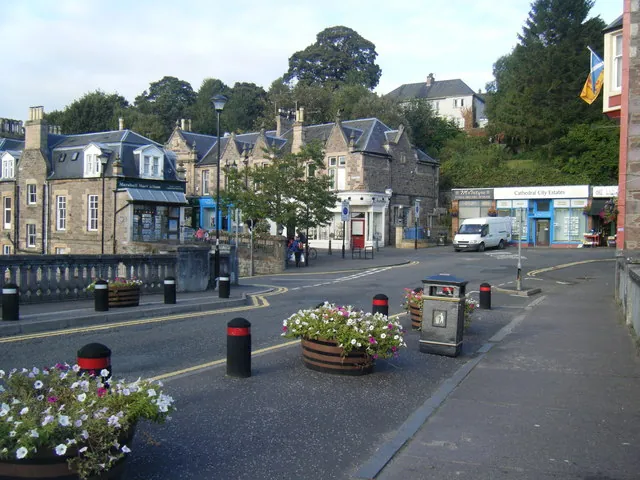
Dunblane is a town on the banks of the Allan Water, a tributary of the River Forth, in the Stirling council area but historically in Perthshire. It had 8,811 people at the 2011 census, an estimated 9,410 by mid-2016, and works today as a commuter town, its residents using the road and rail links into the Central Belt. It is often called a city because of its cathedral, though that status was never officially recognised.
You go from Stirling for one building. Dunblane Cathedral is the town’s landmark, and the journey is about as undemanding as a day trip gets, with trains every fifteen minutes. The town lies 7.7 km straight-line from the centre of Stirling, its station 7.9 km.
The old centre is compact, and much of what rings it is housing from the expansion that has run since the early 1970s. Visitor reviews cover the cathedral only; the museum, the parks and the walks come with no ratings to weigh them by.
The medieval diocese here was neither rich nor large — 37 parishes — so the cathedral is modest in scale, and its reputation rests on the refinement of its architecture and its setting above the valley of the Allan Water. The oldest fabric is an 11th-century bell tower, originally free-standing and later swallowed by the building around it, its height raised in the 15th century. The nave and aisleless choir are 13th century, and two cross-slabs of the 10th to 11th centuries, the earliest evidence of Christianity on the site, are preserved inside.
Its rarest survival is woodwork: the cathedral keeps more of its late-medieval choir stalls than any church building in Scotland apart from King’s College Chapel in Aberdeen, and is noted for its organ. A visitor in June 2026 picked them out unprompted, listing “carved choir stalls I think these are 15th century” among the highlights. Further fragments of the woodwork are displayed in the town museum nearby.
The cathedral carries 4.7 from 893 Google reviews, and the handful in the pack are uniformly positive, a small and one-sided sample. Guiding comes up repeatedly: a visitor in June 2026 wrote that “Julie the guide couldn’t have been more helpful and kind”, and another that month advised speaking to the guide. A visitor in May 2026 mentioned “plenty of information cards around the church”, and cautioned that the building closes over the middle of the day, so do not count on finding it open whenever you arrive. It is still a working parish church, in the care of Historic Scotland.
After the Reformation the nave was abandoned, lost its roof and was used for burials while the choir carried on as the parish church; it was re-roofed between 1889 and 1893, with furnishings by Robert Rowand Anderson. South of the building, stone vaults are the only surviving fragment of the bishop’s palace.
On 13 March 1996, a local man, Thomas Hamilton, shot dead 16 children and their teacher, Gwen Mayor, in the gymnasium of Dunblane Primary School with his licensed weapons, before killing himself. Parliament afterwards banned ownership of most handguns in the United Kingdom. Jamie Murray and Andy Murray were pupils in the school at the time.
Visitors meet this history inside the cathedral, which holds a cenotaph to the victims; there is a memorial to the 17 in the local cemetery, and stained-glass windows in the Church of the Holy Rude, St Blane’s and Lecropt. A visitor in May 2026 wrote of “a very moving memorial to the children and victims from the Dunblane Primary School shooting.”
The school reopened within days; the old gym was demolished, replaced by an extension at the far end of the building, and its site became a memorial garden. Money raised afterwards built, on a community vote, the Dunblane Centre, a youth, family, arts and sports building that opened in 2004 and runs on user revenue and fundraising with no state finance.
Two small institutions sit near the cathedral, both seasonal, so out of season neither is a reliable stop. The town museum occupies a well-preserved late-medieval town house, probably built as the manse of the Dean of the medieval cathedral; formerly the Cathedral Museum, it opens in summer, and free entry. An extension inside its courtyard added exhibition space and disabled access. The 17th-century Leighton Library, founded by Robert Leighton, Bishop of Dunblane from 1661, is the oldest private library in Scotland open to the public, and it opens on selected days in summer.
Next to the cathedral, Scottish Churches House was an ecumenical study centre from the 1960s until 2011 and is now a hotel with a medieval chapel in the grounds. The north side of town is dominated by the Dunblane Hydro, a Victorian survivor of the 19th-century hydropathy boom, in wooded grounds above a steep, wide grass slope.
For open ground, the pack lists Laighhills Public Park, Holme Hill, the forest at Mill of Keir and the Darn Walk, which runs to Bridge of Allan. Sheriffmuir, fought in 1715, is on land very close to the town; many of the combatants were billeted here beforehand.
The train is the obvious way. ScotRail runs every fifteen minutes between Dunblane and Stirling, and from the same station reaches Dundee, Edinburgh Waverley, Glasgow Queen Street and Perth. The station is on Station Road, FK15 9ET, carries 4.7 from 51 Google reviews, and as of 2018 was the northernmost electrified station on the British network. It opened in 1848 on the Scottish Central Railway’s Stirling to Perth line and later became the junction for the route through Doune and Callander towards Oban, closed in 1965 under the Beeching axe.
By bus, local services are run mainly by Stagecoach South Scotland and Scottish Citylink, connecting the town with Stirling, Perth and Edinburgh.
By bike, National Cycle Network Route 765 leaves Stirling city centre for Bridge of Allan, Dunblane and Doune on a mix of quiet roads and traffic-free paths. Bikes go free on ScotRail and the route needs no reservation, so riding out and training back is straightforward.
By road, Dunblane is where the M9 ends and joins the A9 dual carriageway north towards Perth. The A9 once ran through the centre; a bypass was completed in 1991 and the old road became the B8033. Expect difficulty at the other end: rapid growth has sharply increased local car use, and considerable parking problems.
The village and what is around it, at walking scale.
Open any of them in Google Maps for directions and current opening.
Attractions, prices and availability in Stirling
These come from GetYourGuide's booking widget, which sets their cookies in your browser. Consent to load it and see the attractions and prices.
Background on Dunblane draws on its Wikipedia article, text there being available under CC BY-SA 4.0.