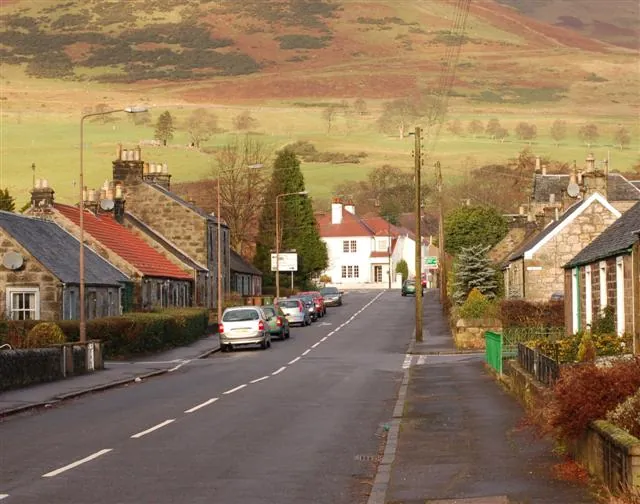
Dollar is a small town in Clackmannanshire with an estimated population of 2,840 in 2020, set between the Ochil Hills to the north and the River Devon to the south. It is one of the Hillfoots towns, and is now largely a dormitory community for people who work in Stirling, Glasgow and Edinburgh.
What brings people out from Stirling is the ground behind the town, not the town itself. Dollar Glen is a wooded gorge, and at its head, on a forward projection of rock on the south side of the Ochils, stands the 500-year-old Castle Campbell. The visit is a climb from the edge of town up to that castle, and reviewers agree it asks something of your legs and shoes.
It sits on the A91 road to St Andrews; the straight-line distance is 17.3 km. It is the furthest of the Stirling trips covered here.
Dollar Glen is in the care of the National Trust for Scotland, 4.8 from 677 Google reviews. The path runs up from a car park below the castle; a visitor in July 2026 gave the measure — “Took about 40 minutes to get from the car park to the glen, passing Campbell Castle on the way” — and described the glen as a place for a picnic, with children playing in the burn that runs through it. Several other walks lead off the main path.
Two warnings recur. The first is footing: a visitor in July 2026 wrote, “The pathways are quite uneven so definitely wear decent shoes, I wouldn’t recommend sandals of any type.” The second is that the two sides of the gorge are not equivalent. A visitor in August 2026 found that “Walking up on ready side was lovely. Walking on the west side of the gorge is hard work and wanting of steps.”
The castle was the lowland seat of the Duke of Argyll, and Mary, Queen of Scots stayed here in the 16th century. It rates 4.7 from 1,033 Google reviews, and reviewers treat the castle and the walk above it as one outing rather than two; a visitor in July 2026 called it a “Gorgeous spot with beautiful trails and waterfalls.”
Inside, it is a 17th-century building behaving like one. A visitor in August 2026 wrote, “Can’t imagine what life was like in the 1600s if you were disabled. Talk about loads of stairs, and every one of them was winding.” Castle Campbell View Point (4.7 from 10 Google reviews) and Dollarbeg Castle (4.8 from 56) sit nearby on very small samples. Iain Banks, who studied at the nearby University of Stirling, said in a 1997 South Bank Show interview that the landscape above Dollar fed his novels, in particular A Song of Stone.
The Japanese Garden at Cowden draws far more reviews than anything else here, 4.7 from 2,543, for ponds with koi, stone lanterns, maples and cherry trees, woodland walks and a café. Entry appears to run on timed slots, and visitors approve. One in July 2026 wrote, “I now understand why they only let a limited number into the gardens on each time slot. If they allowed more in, the gardens would lose the atmosphere that the garden portrays.”
The town street is a 19th-century invention. The original settlement stands on sloping ground beneath the castle, in the northeast of the town — stone houses of two storeys, the oldest from the mid-17th century. Around 1840 a new road to Muckhart was built on lower ground south of the old route, creating the current main east–west street, which quickly took over as the town centre and the focus of the shops.
That street is short. Dollar Museum, volunteer-run, holds local items and much on the former Devon Valley Railway, at 4.7 from 48 Google reviews; The Hive community centre and library carries 4.6 from 43; and Dollar’s Delicatessen, 4.6 from 120, is where a visitor in November 2025 found “Great food to pick up for a picnic in the park.” Not every visit lands well: a visitor in September 2025 was “Really disappointed” at being passed in the queue at the deli counter.
The name has nothing to do with the currency. The likeliest derivation is Pictish dol + ar, “haugh place” or “place of the water-meadow”; another reading is the Gaelic Doilleir, dark and gloomy.
Attempts to mine lead and copper in the glen from the 18th century came to nothing. Textiles drove the town’s growth, as in the other Hillfoots towns, and coal outlasted them: the Upper Hirst seam supplied Kincardine Power Station and later Longannet until 1973, after which a tiny private mine on the Harviestoun estate carried on from the mid-1970s while local demand lasted.
The largest institution is Dollar Academy, founded in 1818 with a bequest from a native of the town, Captain John McNabb, who had allegedly made his fortune in the slave trade; James Dewar, inventor of the vacuum flask, was a pupil. In its grounds a bronze figure with outstretched hands by George Henry Paulin faces westwards, commemorating the fallen of the First World War. Dollar also elected Lavinia Malcolm as provost from 1913 to 1919, the first female provost and the first female town councillor in Scotland.
By road, the A91 runs east out of Stirling through the Hillfoots to Dollar and on towards St Andrews. Parking at the glen is the awkward part: a visitor in August 2026 warned that the “Car parks have what feels like a single track and beware the two deadly potholes.”
There is no railway. Dollar had a station on the Devon Valley Railway, which linked Alloa and Kinross and closed to passengers in 1964. The trackbed came back as something useful — the Devon Way, National Cycle Network Route 767, a fully traffic-free path along the old line from Alloa through Tillicoultry to Dollar, joining Routes 768 and 76 to form the 12-mile Alloa Hillfoots Loop, and the nearest genuinely car-free family day ride to Stirling in these sources. It starts at Alloa, not Stirling, so the leg out of the city is on you.
No scheduled bus or rail service between Stirling and Dollar is established in these sources, so check a current timetable locally rather than assume one.
The village and what is around it, at walking scale.
Open any of them in Google Maps for directions and current opening.
Attractions, prices and availability in Stirling
These come from GetYourGuide's booking widget, which sets their cookies in your browser. Consent to load it and see the attractions and prices.
Background on Dollar draws on its Wikipedia article, text there being available under CC BY-SA 4.0.