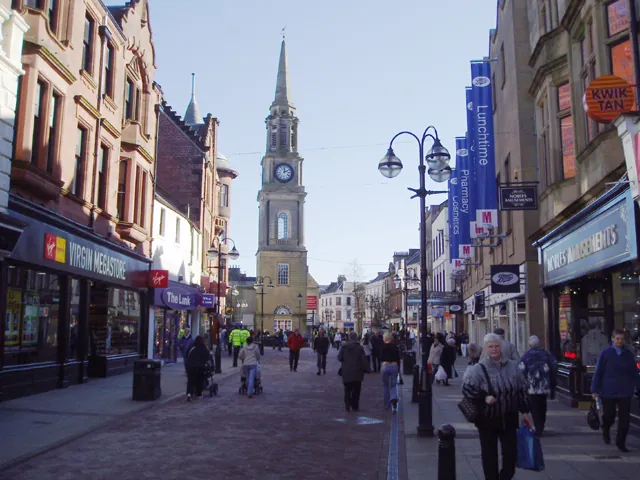
Falkirk is a town rather than a village — 34,627 people at the 2022 census, the twentieth most populous settlement in Scotland, and the administrative centre of its own council area. It sits in the Forth Valley, historically within the county of Stirlingshire, and lives on retail and services now that the heavy industry has gone.
What makes it a day out of Stirling is water. Falkirk stands at the junction of the Forth and Clyde and the Union canals, and nearly everything a visitor comes for is strung along that line: the Kelpies at one end, the Falkirk Wheel at the other. The junction is also why the town grew: it made Falkirk a centre of heavy industry during the Industrial Revolution.
The straight-line distance from Stirling is 16.7 km.; it places the town 23½ miles (38 kilometres) northwest of Edinburgh and 20½ miles (33 km) northeast of Glasgow. In a 2011 poll conducted by STV it was voted Scotland’s most beautiful town.
The Kelpies are two 30-metre-high (98 ft) horse-head sculptures alongside the M9 between Falkirk and Grangemouth, depicting the shape-shifting water spirits of the name. They stand in Helix Park, a land transformation project meant to improve connections between the communities around Falkirk, and at 4.7 from 39,264 Google reviews they are the most reviewed attraction here by a long way. Entry is free.
Reviewers are near-unanimous. A visitor in July 2026 wrote, “Unique piece of sculpture. Nice walk around, area all flat.” Another that month rated them “More impressive than the Angel of the North”, and noted a café and shop on site and tours inside either sculpture — the two are named Baron and Duke.
The car park is the catch. A visitor in August 2026 reported, “Visited in the English school holidays on a Friday (in the afternoon) and couldn’t get into the carpark so had to turn around and go to the football stadium.” That overflow is Falkirk Stadium, 4.2 from 2,083 Google reviews, home to Falkirk F.C., Scottish Cup winners in 1913 and 1957.
The Forth and Clyde Canal opened in 1790 and the Union Canal followed in 1822, giving a link to Edinburgh; railways came in the 1830s and 1840s, and the trunk roads and motorways later followed the same corridors. The canals made the town’s money.
The Falkirk Wheel, completed in 2002, joins the two, and it the only rotary canal connector in the world. The Falkirk Canal Tunnel is listed separately at 4.6 from 431 Google reviews. The Forth and Clyde Canal itself carries 4.6 from only 10 Google reviews, too small a sample to mean much.
Callendar House is a mansion with a 600-year history, now a public museum with a café, a shop and the Park Gallery for contemporary art, standing in 180 acres (75 hectares) of open-access parkland. William Forbes of Callendar, proprietor of the Carron Iron Works and the largest landowner in Stirlingshire, was seated here.
House and park both carry 4.6, from 2,207 and 2,032 Google reviews, and both are free. A visitor in June 2026 wrote, “Very quiet and peacefully. Was able to view the house and different rooms at my pace.” One in July 2026 described “wandering the forest trails or watching the ducks by the lake”; there is also an enclosed play park, an aerial slide and a tearoom.
Not all of it is kept up. A visitor in June 2026 was blunt: “much of the stone masonry such as ourside Callandar House, and the bridge behind it is in alot of disrepair”.
The park also holds remnants of the Antonine Wall, the northern frontier of the Roman Empire between the Firths of Forth and Clyde in the AD 140s. It was built of turf rather than stone, so less of it survives than of Hadrian’s Wall. Much of the best evidence of Roman occupation in Scotland has been found in Falkirk: a large hoard of coins and a cloth of tartan thought to be the oldest ever recorded.
Falkirk was the earliest major centre of Scotland’s iron-casting industry. James Watt cast some of the beams for his early steam engine designs at the Carron Iron Works in 1765, and the Carron Company turned out kitchen ranges, fireplaces and railings, carronades for the Royal Navy and, later, pillar boxes and telephone boxes. Falkirk was also the first town in Great Britain with a fully automated system of street lighting.
Two battles were fought here. At the Battle of Falkirk on 22 July 1298 William Wallace was defeated by Edward I; at the Battle of Falkirk Muir on 17 January 1746 the Jacobites under Charles Edward Stuart beat a government army under Lieutenant General Henry Hawley.
The centre itself is modest. The Falkirk Steeple of 1814, on the High Street that was pedestrianised in the late 1980s, is category A listed and treated as the town’s centre point; its outline appears on Falkirk F.C.’s crest. The Howgate Shopping Centre opened in April 1990; Callendar Square, opened in 1993, closed in 2020 and is to be replaced by a new town hall, theatre and library.
The bus is the direct option. Falkirk’s bus station closed on 20 August 2018 and its routes — including the links to Stirling, Edinburgh and Glasgow — moved to Newmarket Street in the town centre. Services are run mainly by McGill’s Midland Bluebird, with a few Stagecoach South Scotland routes. Stirling’s own bus station is 0.2 km from the centre, on Goosecroft Road.
Falkirk has two railway stations. Falkirk Grahamston, 15.8 km from central Stirling and 4.0 from 68 Google reviews, is on the Edinburgh to Dunblane line — the line Stirling itself sits on. Falkirk High is on the Glasgow–Edinburgh main line, with eight trains an hour at peak, but no Stirling service is listed from it. Camelon station in the neighbouring town is closer to Stirling still, at 14.3 km. No Stirling-to-Falkirk journey time is recorded in the sources behind this page, so check a timetable.
By road, the area has direct access from the M9 to the north and east and the M876 to the west. Bike hire and repair are available in Falkirk itself, though no cycle route between the two towns is established here.
The village and what is around it, at walking scale.
Open any of them in Google Maps for directions and current opening.
Attractions, prices and availability in Stirling
These come from GetYourGuide's booking widget, which sets their cookies in your browser. Consent to load it and see the attractions and prices.
Background on Falkirk draws on its Wikipedia article, text there being available under CC BY-SA 4.0.