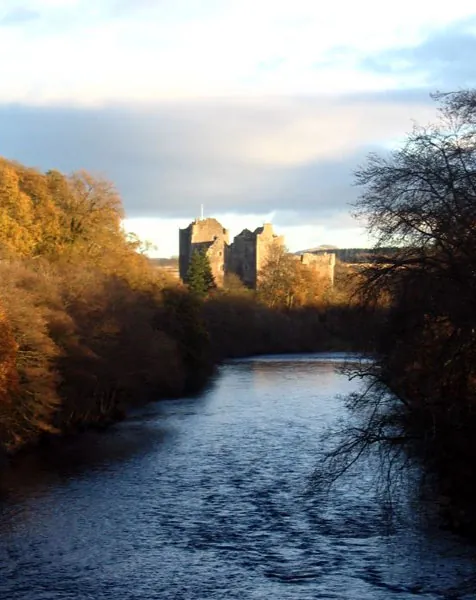
Doune is a burgh in Perthshire, administered by Stirling Council and — a quirk of the postal map — assigned Falkirk postcodes beginning “FK”. The name comes from the Scottish Gaelic An Dùn, ‘the fort’. The town sits in the parish of Kilmadock, mostly within the ground enclosed by the River Teith and the Ardoch Burn, and it is 10.3 km from Stirling in a straight line..
The reason to make the trip is a single building. Doune Castle, built in the late 14th century, is architecturally a mixture of fortress and manor house; what made it famous is film. Monty Python and the Holy Grail was shot here, and the castle has since carried Ivanhoe, Game of Thrones and Outlander. Most people coming from Stirling come for one of those.
Around it is a small town rather than a resort. The primary school had 183 pupils on the roll in June 2016, drawn from a catchment reaching well north of the town, and 2.75% of residents could speak Scottish Gaelic at the 2001 census. The local amateur football side is called Doune Castle AFC.
Doune Castle carries 4.5 from 7,809 Google reviews. The comments gathered for this guide are few and uniformly positive — a handful of voices rather than a survey. They agree on three things.
The first is scale. A visitor in August 2026 wrote, “A very nice place, small but worth visiting. Well preserved and managed. The panoramic views are beautiful and it is located in a peaceful place.” Small is the operative word.
The second is the audio tour, which reviewers single out more than the building itself. A visitor in August 2026 wrote, “I enjoyed the audio tour (especially the bits narrated by Jamie of Outlander). The staff were also helpful and welcoming.”
The third is that the film association ambushes people who did not plan for it. A visitor in August 2026 wrote, “Made the decision to stop and check it out and had no idea we’d be stepping into the damn holy grail castle.” The same review adds a practical note: “The trail out back is lovely too. Watch out for the slugs.”
Bonnie Prince Charlie passed through Doune in 1745. The town’s other claim is manufacture: Doune was famous for its pistols, a trade that ceased under competition from manufacturers elsewhere — Birmingham among them, where production was cheaper. The guns are now collectors’ items held in major museums, including the Museum of Scotland in Edinburgh. Allegedly a Doune pistol fired the first shot of the American War of Independence — the claim is traditional rather than proven.
The land east of Doune belonged to the Stirling of Keir family, who still own much of the ground around Keir House although the house itself was sold, and whose Keir Estates are now owned by the politician Archie Stirling. David Stirling, founder of the SAS, came from that family and is memorialised by a monument on Keir land near Doune known as the Hill o’ Rou.
The primary school stands on the site of Doune Roman fort. Excavation by Headland Archaeology investigated three ditches and the base of a rampart, and found five circular stone bread ovens set into the back of that rampart, with a gravel track behind them read as the intervallum way, one of the fort’s internal roads. The foundations of a probable hospital came up too, along with an iron-smelting shaft furnace — a first for Roman Scotland. Fragments of samian ware and amphorae date the site to the Flavian period and the first Roman incursion into Scotland, from 79 AD to the mid-80s. The remains are a scheduled monument.
The area was occupied far longer, and burial mounds and standing stones are plentiful — though some ground is gone. The ground behind the town where the ponds and the Doune Riggs housing now sit was known locally as Currachmore, and held the bluebell wood, popular with walkers, and part of the Doune golf course; it was quarried, and the sand went into the construction of Longannet. The quarry also removed the Round Wood, a mound 150 yards (140 metres) long, 100 yd (90 m) wide and 30 ft (9 m) high. During the work a stone cist was uncovered containing the remains of a boy of about six, buried with a small stone axe and identified as one of the Beaker people of the early Bronze Age, around 1800 BC. The mound itself is not there any more.
Doune keeps the fairy tales common to Celtic country, attached to specific ground. Ternishee, a small wood east of the Annat chapel above Doune Lodge and 1½ miles (2.5 kilometres) from the town, takes its name from the Scottish Gaelic tìr na sìdhe, ‘land of the fairies’. Fairy dancing parties are recounted on the Fairy Knowe, a hillock on the right bank of the Ardoch half a mile (800 metres) east of Doune, and near the Bridge of Teith, on the low road to Callander, a burial mound called Tullochanknowe is said to be a favoured haunt.
The other fixture is motorsport. Doune Speed Hillclimb is described as the most prestigious hillclimb course in Scotland and hosts a round of the British Hill Climb Championship each year. No dates for it appear in the sources behind this guide.
The route this guide can actually document is the bike. National Cycle Network Route 765 leaves Stirling city centre for Bridge of Allan, Dunblane and Doune over a mix of quiet roads and traffic-free paths, and a local bike shop describes the Stirling-to-Doune run as an easy 11-mile ride. Temper that against Stirling’s cycling infrastructure, scored 68 out of 100 by one guide and not fully segregated. There is a bike shop at the Doune end — Roots Cycles, 5.0 from 250 Google reviews, on Station Wynd, 11.2 km from the Stirling centre.
That street name is a fossil. Doune used to be served by Doune railway station, and no longer is; the railheads are back in Stirling and Dunblane. Nothing in the sources behind this guide establishes a bus service between Stirling and Doune, so confirm public transport locally rather than assume it.
Ashmill Caravan Site at Doune, 4.7 from 139 Google reviews, sits 10.8 km from the Stirling centre.
The village and what is around it, at walking scale.
Open any of them in Google Maps for directions and current opening.
Attractions, prices and availability in Stirling
These come from GetYourGuide's booking widget, which sets their cookies in your browser. Consent to load it and see the attractions and prices.
Background on Doune draws on its Wikipedia article, text there being available under CC BY-SA 4.0.