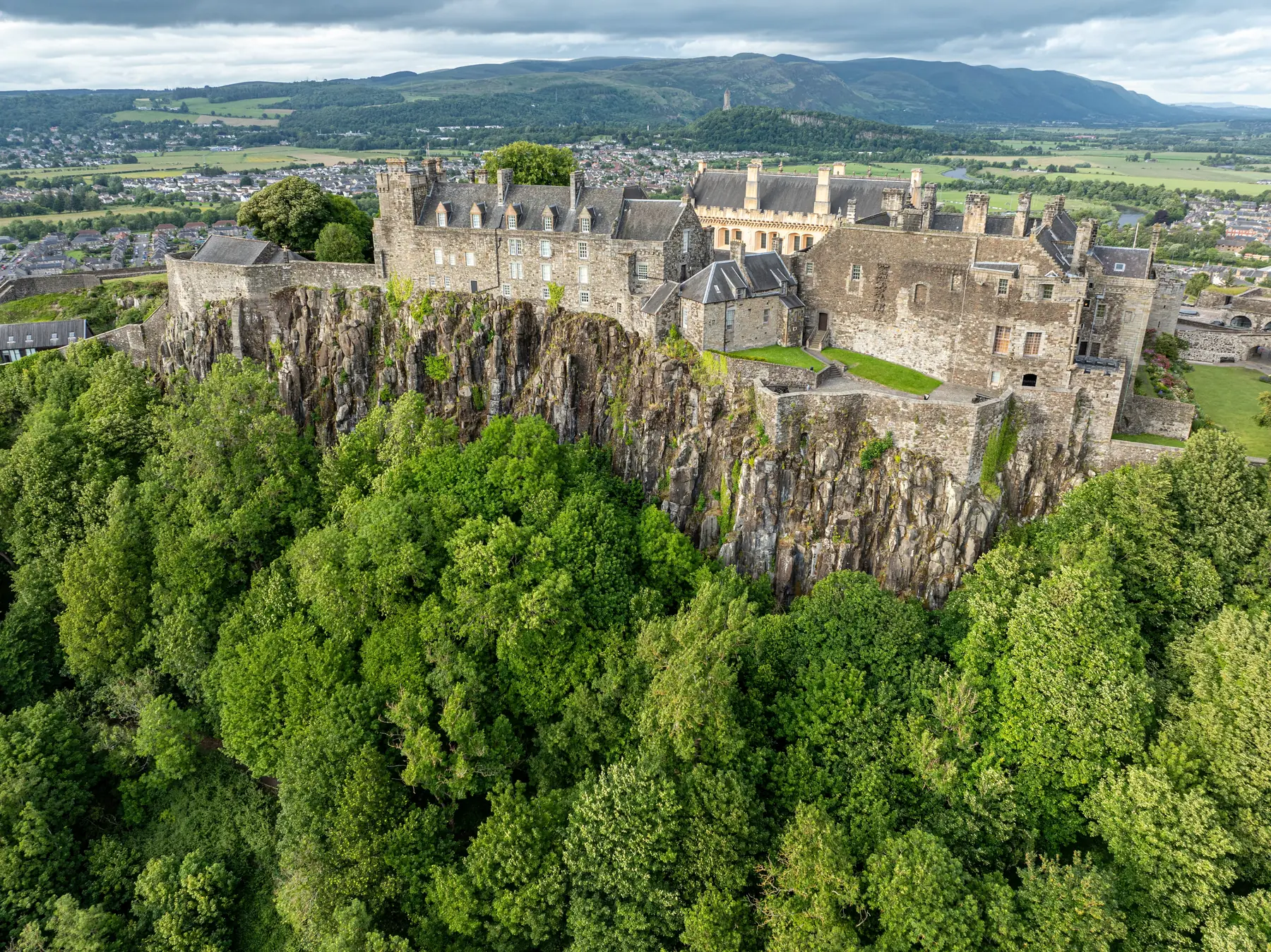
The castle and the monument charge, and both are worth it. Almost everything else in Stirling is free, and there is a great deal of it: one of the best-preserved town walls in Scotland with a path round it, a free museum with the oldest football in the world in it, a royal abbey in a river meander, a coronation church, a hunting park and a set of waterfall glens along the Ochils.
Stirling’s sixteenth-century town wall is among the best preserved in Scotland, and a path — the Back Walk — follows its line around the base of the castle crag from the bottom of the old town to the esplanade.
It takes about an hour, it is signposted, and on the way it passes the Beheading Stone on Mote Hill, the Old Town Cemetery and the Valley Cemetery with their extraordinary monuments — including the Star Pyramid, a solid stone pyramid raised in the 1860s to commemorate the Scottish Reformation, and the marble statues of the Wigtown Martyrs under a glass dome.
Free, and the single best thing to do in Stirling without paying.
Walking down from the castle esplanade costs nothing and takes you past:
Argyll’s Lodging — the finest seventeenth-century townhouse in Scotland, free to look at from outside.
Mar’s Wark — the ruined Renaissance frontage of a great house begun in the 1570s and never finished, standing open at the top of Broad Street.
The Church of the Holy Rude — free to enter in season, and the church where the infant James VI was crowned in 1567. The medieval oak roof survives, and so does musket damage from the Civil War.
Broad Street and the old town’s closes, which is where the merchants and tradesmen lived.
Free, five minutes from the town centre, and a proper museum. Founded in 1874 on the bequest of the artist Thomas Stuart Smith, it holds the city’s art and history collections — including the oldest football in the world, a sixteenth-century leather ball found behind panelling in Stirling Castle, and the oldest surviving curling stone. There is a café and a good exhibition programme.
King’s Park, below the castle, was the royal hunting park and is now the city’s main open space.
The King’s Knot — the geometric earthwork terraces below the castle rock, the surviving form of a formal royal garden laid out in the 1620s. Free, and best appreciated from the castle walls above.
Riverside Park and the Forth walkways run along the river through the city.
Cambuskenneth Abbey, a kilometre and a half east across a footbridge, is a twelfth-century Augustinian abbey in a meander of the Forth. Robert the Bruce held a parliament here after Bannockburn, and James III and his queen are buried on the site. What survives is a fine detached bell tower and the ground plan. Free, open, and almost always empty.
Abbey Craig, three kilometres north-east, is the wooded hill from which Wallace is said to have watched the English cross Stirling Bridge in 1297. The walk up through the woods is free; only the Wallace Monument at the top charges. The view from the hill itself is most of the reward.
The Bannockburn site — the National Trust for Scotland visitor centre charges, but the rotunda, the flagpole and the great equestrian statue of Robert the Bruce on the traditional site are free to visit and open.
Stirling Bridge — the medieval bridge that survives is the fifteenth-century replacement rather than the wooden one of 1297, but it stands where the battle was fought and it is free to walk over.
Along the foot of the Ochils east of the city, a series of steep wooded ravines cut into the escarpment, all free to walk:
Alva Glen, ten kilometres east, is the best — waterfalls, bridges and a path climbing beside the burn.
Menstrie, Tillicoultry and Dollar glens follow; Dollar Glen climbs to Castle Campbell, which charges but is spectacularly sited.
Dumyat, the 418-metre western end of the Ochils, is free to climb and gives the best view in the district.
Flanders Moss, fifteen kilometres west, is a national nature reserve over one of Europe’s best-preserved raised bogs, with a free boardwalk and a viewing tower.
The Kelpies at Falkirk, twenty minutes east, are two thirty-metre horse-head sculptures beside the canal in a free public park — one of the most-visited attractions in Scotland and free to walk around.
Callendar House at Falkirk is a large mansion with a Georgian kitchen, a museum and a park, and it is free.
Parking, and the two big-ticket attractions. Stirling’s centre is compact enough to leave the car once, and the station is in the middle of the city with frequent trains from Glasgow and Edinburgh in about fifty minutes each — which makes a day here entirely practical without a car.
Historic Environment Scotland and National Trust for Scotland memberships both cover several sites in the area if you already hold one.
Start on the Back Walk and follow the town wall up to the castle esplanade for the view. Come down through the old town past Mar’s Wark and the Holy Rude, and spend an hour in the free Smith Art Gallery. Lunch in the town. In the afternoon cross the footbridge to Cambuskenneth Abbey, then walk or take the bus to Abbey Craig and up through the woods for the view over the Forth valley. Finish in King’s Park looking at the King’s Knot.
A town wall, a coronation church, a royal abbey, a free museum and the best view in central Scotland, for nothing.
Stirling’s year has more free content than a city this size usually manages. The Highland games at Bridge of Allan and elsewhere in the district run through the summer — ticketed for the arena, free in the atmosphere. The city runs a programme of events on the esplanade and in the parks, and the university’s public lectures and exhibitions are open to anyone in term.
Doors Open Days in September opens buildings across the district that are normally closed, free of charge, and it is the best week of the year to be nosey in Stirling.
Worth checking. Stirling Castle, Doune Castle, Cambuskenneth Abbey and Castle Campbell are Historic Environment Scotland; Bannockburn, Alloa Tower and the Hermitage are National Trust for Scotland. Both organisations have reciprocal arrangements with their English and Welsh equivalents, so an existing English Heritage or National Trust membership may go further here than you expect.
Yes, and it holds the oldest football in the world.
Yes — the woodland path up the hill is free. Only entry to the Wallace Monument at the top is charged.
Yes, and it is a short walk across a footbridge from the city.
The rotunda, the flagpole and the Bruce statue are free and open; the visitor centre and battle experience charge.
Yes — the sculptures stand in a free public park at Falkirk, twenty minutes east.