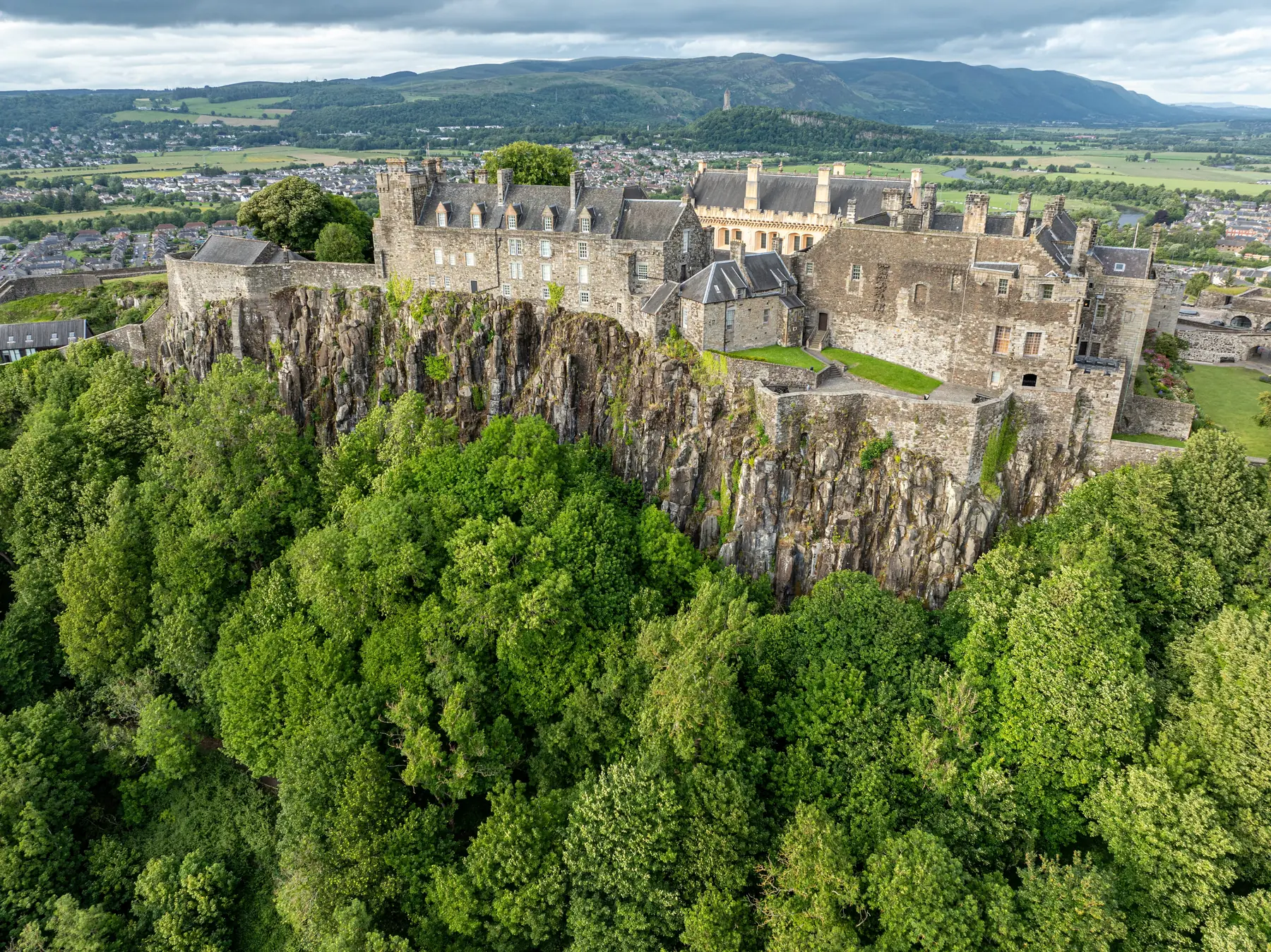
Stirling sits in the middle of Scotland where the Highland weather meets the Lowland, and it gets a reasonable share of both. It is not as wet as the west coast — the city is in the lee of the Trossachs — but a week here without rain would be lucky.
The good news is that Stirling is a city rather than a village, with a very large castle, a free museum, a Victorian jail and a battle simulator, and a ring of indoor attractions within twenty minutes.
The obvious answer and a very good one. The castle is enormous and most of it is under a roof: the Great Hall, the Chapel Royal, the restored Royal Palace with its painted ceilings and the carved oak Stirling Heads, the Great Kitchens laid out mid-banquet, the tapestry studio, the Argyll and Sutherland Highlanders Regimental Museum, and two cafés.
Allow three hours, more if the costumed interpreters catch you. The battlements are exposed, but you can spend most of a wet day inside without repeating yourself.
On a wet morning, treat the esplanade as optional and go straight into the buildings. Costumed interpreters work the palace in season, and they are the reason to arrive at opening rather than at eleven, when every other wet-day visitor has had the same thought. The two cafés are inside. The battlements can wait until a shower passes — the view is the point of them, and there is none in low cloud.
Founded in 1874 on the bequest of the artist Thomas Stuart Smith, and free. It holds the city’s art and local history collections, including — genuinely — the oldest football in the world, found behind panelling in the castle’s Queen’s Chamber and dating from the sixteenth century, and the oldest surviving curling stone. There is a good café and a changing exhibition programme.
An hour and a half, and the best free indoor hour in Stirling.
It sits on Dumbarton Road, a short walk from the centre, with its own grounds — so you are not standing on a pavement between rooms. Wet days send a lot of people up to the castle and fewer to the Smith, which is useful. The football and the curling stone are the objects people come for; the rest is Stirling’s civic history, and the café does not need a ticket. It is not open every day of the week — check the Smith’s own hours before you walk down in the rain.
A Victorian prison on St John Street run as a live attraction with costumed performances and cells you go into, plus a viewing tower with a panorama over the town and the Ochils. It is also the tourist office. An hour.
It is an independent attraction, not part of the castle ticket. Book the tour rather than hoping to walk in when the castle has just closed in the rain.
Free, open in season, and the church where the infant James VI was crowned in 1567 — one of very few in Britain still in use to have hosted a coronation. The medieval oak roof and the Civil War musket damage are both worth looking for.
The finest seventeenth-century townhouse in Scotland, on Castle Wynd. Opening arrangements vary — sometimes by guided tour from the castle — so check.
Three kilometres south, and entirely indoors. The centrepiece is a 3D immersive experience in which projected medieval soldiers move around you, followed by an interactive battle game where visitors command the two armies. It is a good two hours and it works particularly well with older children.
The rotunda and the Robert the Bruce statue outside are free and open even if you skip the paid centre, but they are exposed. It shares the castle’s wet-weather crowd, so the first sitting of the day is the civilised one.
Ten kilometres north-west. A remarkably complete fourteenth-century castle with a great hall, kitchen tower and wall walks, most of it roofed. It is also the most-filmed castle in Scotland — Monty Python, Game of Thrones, Outlander — and the audio guide narrated by Terry Jones is the reason a good many people go.
Counterintuitively good in rain, because the main reserve is a drive-through and you stay in the car. The walk-round sections and the indoor play areas cover the rest.
The Falkirk Wheel is a rotating boat lift raising canal boats twenty-four metres between the Forth and Clyde and Union canals. You can take a boat trip on it, which runs in most weather, and the visitor centre is indoors.
Callendar House at Falkirk is a large mansion with a Georgian kitchen staffed by costumed cooks, a museum and a café — and it is free.
The Kelpies, the thirty-metre horse-head sculptures, are outdoors but take ten minutes and are more dramatic under a grey sky than a blue one.
A boat trip on the Wheel is the thing to book; the visitor centre and café cover the wait. Callendar House is the quieter indoor hour, and the two combine easily in an afternoon from Stirling.
Glasgow and Edinburgh are both around fifty minutes by train from a station in the middle of the city, which makes a full wet-day escape to either straightforward — Kelvingrove and the Burrell in one direction, the National Museum and the galleries in the other.
Perth, half an hour north, has Scone Palace and the Black Watch Museum.
Alva Glen and the hillfoots glens need rain to be at their best — the waterfalls are the point. After a wet night the burns come up and the gorge is why the path exists. It is a short drive east to the hillfoots, and you can turn around as soon as you have had enough.
The Back Walk round the town wall is short, partly wooded and easy to abandon.
Plean Country Park and the woodland at Gartmorn have tree cover.
Avoid Dumyat and the Ochil tops in low cloud — the escarpment is steep and there is nothing to see.
Trains to Glasgow, Edinburgh and Perth run frequently from the city centre station.
The castle and the Bannockburn centre both get busy on wet days, as everyone has the same idea. Go early.
Seasonal hours. Historic Environment Scotland sites reduce hours in winter, and Argyll’s Lodging and the Holy Rude have limited opening. Check.
Free options. The Smith and Callendar House at Falkirk are both free and both are real museums.
The shape that works: Stirling Castle from opening until early afternoon, which is three hours largely indoors and the best of them. Lunch in the old town or at the castle. Then the free Smith Art Gallery for an hour, or the Old Town Jail for the performance. Finish with a pub below the castle.
If the rain has settled in for the day, drive twenty minutes east to Falkirk for Callendar House, which is free and indoors, and a Falkirk Wheel boat trip, which runs in most weather. Or take the train to Glasgow or Edinburgh, both under an hour, and use the museums.
Stirling sits between the west coast, which is very wet, and the east coast, which is not. The Trossachs and Loch Lomond to the west catch the Atlantic weather first, and the city is measurably drier than Glasgow forty kilometres away.
The practical consequence is that a bad forecast for the Trossachs does not necessarily mean a bad day in Stirling, and if the west is under cloud, going east — to Falkirk, the Ochils or the coast — is often the better call. Look at the two separately.
Stirling Castle for half a day, the free Smith Art Gallery, the Old Town Jail, and the Bannockburn battle experience three kilometres south.
Yes, and it holds the oldest football in the world, found behind panelling in Stirling Castle.
Doune Castle, the Falkirk Wheel, or the train to Glasgow or Edinburgh, both under an hour.
Yes, more than you would expect — the main reserve is a drive-through and there are indoor play areas.
A great deal of it: the Great Hall, the palace, the kitchens, the chapel, the regimental museum and two cafés.