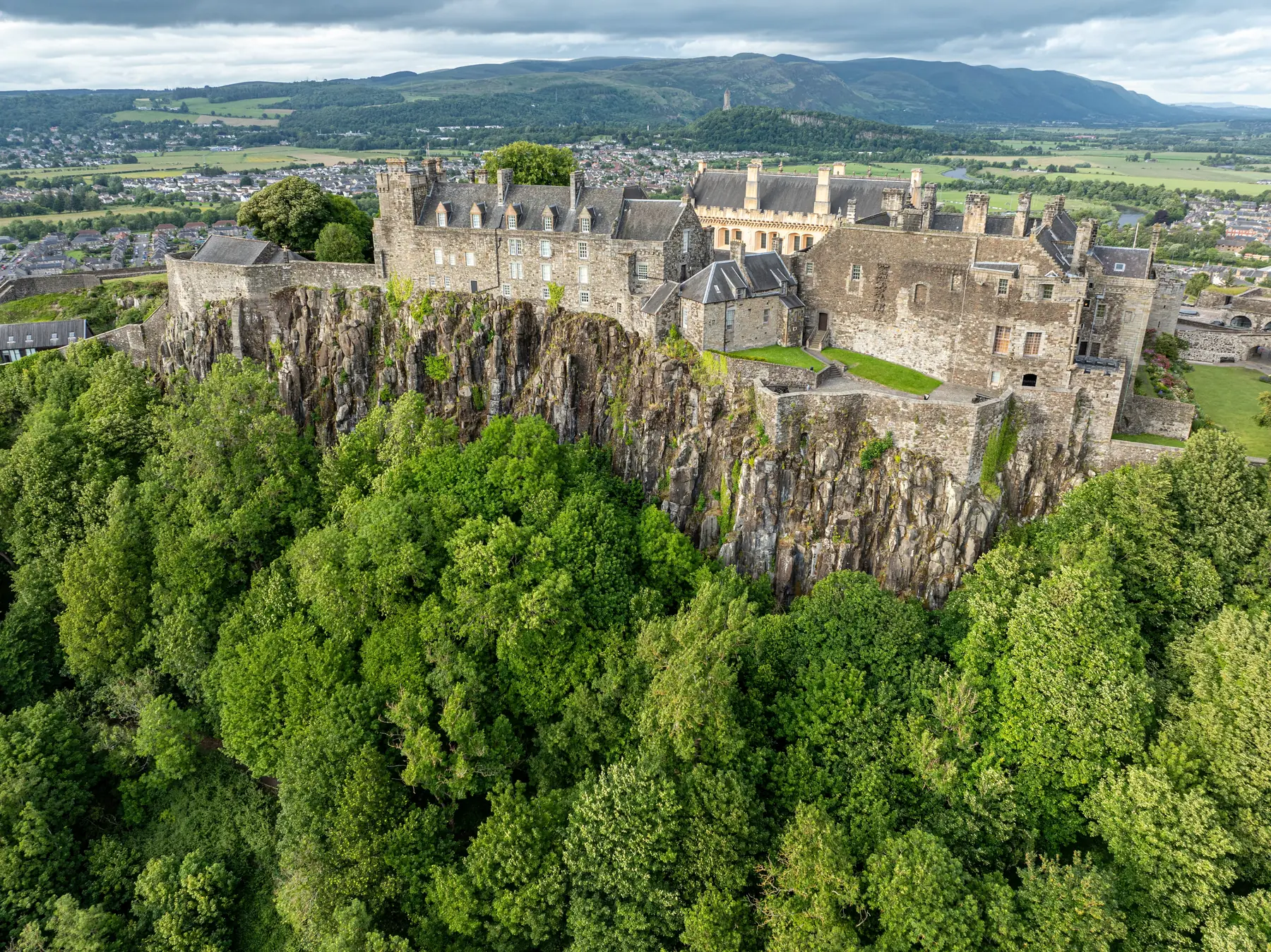
Two of the most famous battles in Scottish history were fought within three kilometres of Stirling Castle, seventeen years apart, and for the same reason: whoever held the crossing of the Forth here held the route between the Highlands and the Lowlands, and therefore held Scotland.
You can visit both sites in a morning, and a Victorian tower on the hill between them commemorates the first.
In September 1297 an English army under the Earl of Surrey and Hugh de Cressingham approached Stirling from the south. A Scottish force under William Wallace and Andrew Moray waited on the north side of the Forth, on and around Abbey Craig.
The only crossing was a narrow wooden bridge that could take about two horsemen abreast. The English began to cross. When enough had come over to be attacked but not enough to fight properly, the Scots came down off the high ground and cut them off at the bridgehead. The bridge became a bottleneck and then a trap; a large part of the English army was destroyed on the north bank while the rest watched from the south.
It was one of the very few occasions on which a Scottish force met an English army in the open and won outright, and it made Wallace’s reputation. Moray was mortally wounded and died within weeks, which historians generally regard as a considerable loss.
What to see: the wooden bridge is long gone. The Old Stirling Bridge that stands today is a fifteenth-century stone replacement, a few metres from the site of the original, and it is free to walk across. Abbey Craig above it carries the Wallace Monument.
Victorian Scotland decided Wallace needed a monument and built one on the shoulder of Abbey Craig, where he is said to have watched the army approach. It opened in 1869: a 67-metre Gothic tower of local sandstone, crowned with a stone version of an imperial crown.
Inside there are 246 steps and three exhibition levels. The first holds Wallace’s sword — a two-handed blade over a metre and a half long — and the story of the battle. The second is the Hall of Heroes, a gallery of marble busts of Scots deemed worthy of commemoration by the Victorians, which is a period piece in itself. The third covers the monument’s own construction.
At the top, the crown-shaped viewing platform gives one of the great views in Scotland: the Forth winding across the carse, Stirling Castle on its crag, the Ochils, Bannockburn, and the Highlands beyond.
Practicalities: the walk up through the woods from the car park takes about twenty minutes and is free; there is a shuttle bus for those who would rather not. The tower charges, the steps are steep and the staircase is narrow with passing places. Allow an hour and a half in total. See our Wallace Monument page.
Seventeen years later, Robert the Bruce faced the largest English army ever to enter Scotland, led by Edward II, marching to relieve the garrison of Stirling Castle.
The battle was fought over two days in June 1314 on ground of Bruce’s choosing — boggy carse land between the Bannock Burn and the Forth, where cavalry could not manoeuvre and the English army’s size counted against it. On the first day Bruce killed the English knight Henry de Bohun in single combat with an axe, in front of both armies, which did a good deal for morale. On the second the Scottish schiltrons — dense formations of spearmen — advanced against the crowded English lines and broke them.
Edward II escaped; the English army did not. It was the decisive battle of the First War of Scottish Independence, and it secured Bruce’s kingship.
What to see: the exact site of the fighting has been argued over for a century and is not settled. What exists is the traditional site, three kilometres south of Stirling, where the National Trust for Scotland runs the Battle of Bannockburn Visitor Centre.
The centre’s approach is unusual: rather than displaying objects, it uses 3D projection to put you among the medieval soldiers, and then hands visitors command of the two armies in a large interactive battle game played on a table map. It suits older children and adults, it takes about two hours, and it is genuinely well done.
Outside, free and open, are the rotunda, the flagpole and the great equestrian statue of Robert the Bruce by Pilkington Jackson, unveiled in 1964.
The two sites are five kilometres apart with the castle between them, and a day that takes in all three is the best possible introduction to why Stirling matters.
Morning: Bannockburn visitor centre and the Bruce statue. Midday: Stirling Castle, from whose walls you can see both battlefields. Afternoon: the walk up Abbey Craig and the Wallace Monument.
Add Cambuskenneth Abbey, where Bruce held a parliament after Bannockburn and where James III is buried, and the whole thing joins up.
Both battles have been thoroughly mythologised, and it is worth going with some scepticism intact. Braveheart is not a reliable guide to anything, including what Wallace wore, where he came from or what happened at Stirling Bridge — where, notably, there was a bridge, which the film omits. Andrew Moray’s role at Stirling Bridge was probably as significant as Wallace’s and is generally forgotten.
The Wallace Monument itself says as much about Victorian Scotland — which built it by public subscription in the 1860s — as about the thirteenth century. That does not make it less interesting; it makes it two historical sites at once.
The Bannockburn centre is on the southern edge of Stirling and reachable by local bus. The 3D experience and the battle game are timed and need booking in advance, particularly in summer — turning up and hoping is not reliable. The rotunda, the flagpole and the Bruce statue outside are free and open at all times.
The Wallace Monument has a car park at the bottom of Abbey Craig with a shuttle bus up the hill, or a twenty-minute woodland walk. The tower’s 246 steps are on a narrow spiral staircase; there are passing places and rest points, but it is not suitable for anyone with mobility difficulties, and it closes in high wind.
Old Stirling Bridge is free, open and a five-minute walk from Causewayhead.
Both paid sites have cafés and shops. Allow two hours at Bannockburn and an hour and a half at the monument.
At the crossing of the Forth below Abbey Craig, just north of Stirling. The original wooden bridge is gone; the surviving Old Stirling Bridge is a fifteenth-century replacement nearby.
Three kilometres south of Stirling, though the precise location has long been disputed. The National Trust for Scotland visitor centre stands on the traditional site.
246, on a narrow spiral staircase with passing places, to a crown-shaped viewing platform.
It is displayed as such and has been associated with him for centuries; its history before the sixteenth century cannot be established.
Yes, easily — they are five kilometres apart with Stirling Castle between them.