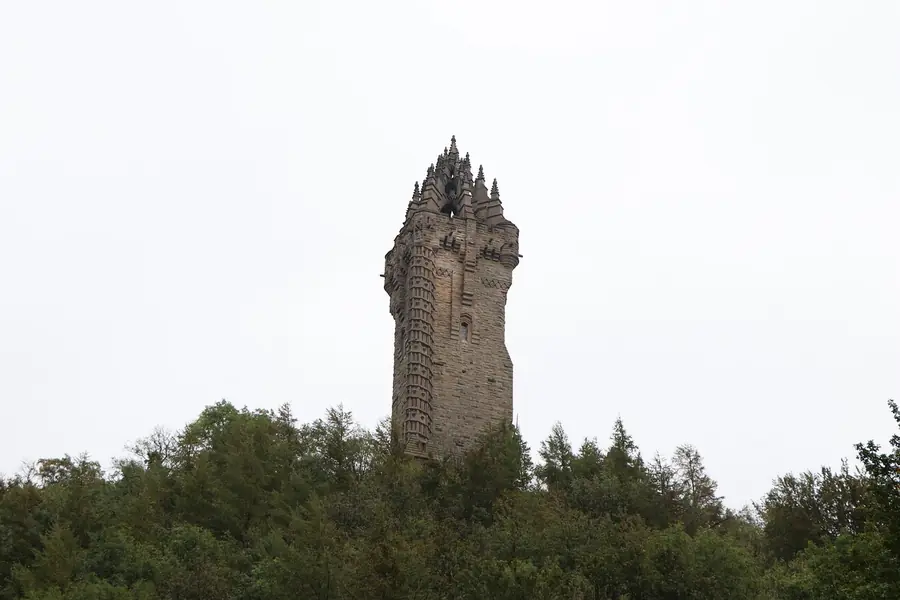
The National Wallace Monument stands on the shoulder of the Abbey Craig, a wooded volcanic hill three kilometres north-east of Stirling, and it is a 67-metre — 220-foot — tower commemorating Sir William Wallace.
It was built between 1861 and 1869, funded by public subscription from Scotland and from Scots abroad, in a Scottish Baronial style by the architect John Thomas Rochead.
Because of what happened below it.
On 11 September 1297, Wallace and Andrew Moray watched an English army under the Earl of Surrey and Hugh de Cressingham begin to cross Stirling Bridge — a narrow wooden bridge over the Forth, two abreast.
They waited until roughly half the army was across, then attacked and seized the bridgehead, cutting the force in two with the river between them. The English vanguard was destroyed; the rest could not get across to help. Cressingham, the deeply unpopular treasurer, was killed and his skin reportedly cut into strips as souvenirs.
The Battle of Stirling Bridge was the first major Scottish victory of the Wars of Independence, and it was won by a smaller force using the ground. The Abbey Craig is where the Scots assembled.
246 steps up a narrow spiral staircase to the crown at the top.
It is a genuine climb — tight, steep and continuous, with landings at each of the three exhibition galleries where you can catch your breath.
The Hall of Arms — the ground gallery, on the battle itself and on Wallace’s campaign.
The Hall of Heroes — busts of sixteen notable Scots, a very Victorian idea of a national pantheon.
The Royal Chamber — on the monument’s own building and the nineteenth-century Scottish identity that produced it.
The Wallace Sword — a two-handed sword, 1.63 metres long, traditionally his. Its authenticity is debated and the blade has certainly been reworked, but it is a formidable object and it is the thing everyone comes to see.
From the crown: Stirling Castle on its own crag across the valley, the Ochil Hills, the Forth winding through its floodplain in extraordinary meanders, the Trossachs and, on a clear day, Ben Lomond.
It is one of the finest views in central Scotland, and the two crags facing each other across the carse — castle and monument — is the whole geography of Scottish history in one frame.
The monument is at the top of the Abbey Craig, and there is a climb from the car park before you even reach the tower — a wooded path of about ten to fifteen minutes, moderately steep.
A shuttle bus runs from the visitor centre to the top for those who want it, and is included or available at small cost.
On the way down, take care with the route: several paths lead off the hill and not all of them return to the car park — visitors report ending up some distance away. Follow the signs.
Admission charged.
Time: ninety minutes to two hours.
Facilities: visitor centre, café, gift shop — well regarded — toilets at the base.
Access: the tower is not accessible — 246 spiral steps with no lift. The visitor centre, grounds and the shuttle to the top are accessible, and the view from the base is still excellent.
Busy: it gets crowded in summer, though the tower’s stair regulates the flow.
Getting there: Hillfoots Road, Causewayhead, about three kilometres from Stirling — a short bus ride, or a walk of forty minutes.
246, up a narrow spiral staircase, with exhibition galleries at three levels to break the climb.
It is traditionally Wallace’s, but its authenticity is debated and the blade has been reworked. It is a genuine two-handed sword of great size.
Wallace and Andrew Moray destroyed an English army in 1297 by attacking while it was crossing a narrow bridge, cutting it in two.
The tower is not — there is no lift. The visitor centre, grounds and shuttle to the summit are, and the views from the base are excellent.
Yes, ten to fifteen minutes up a wooded path from the car park, or take the shuttle bus.