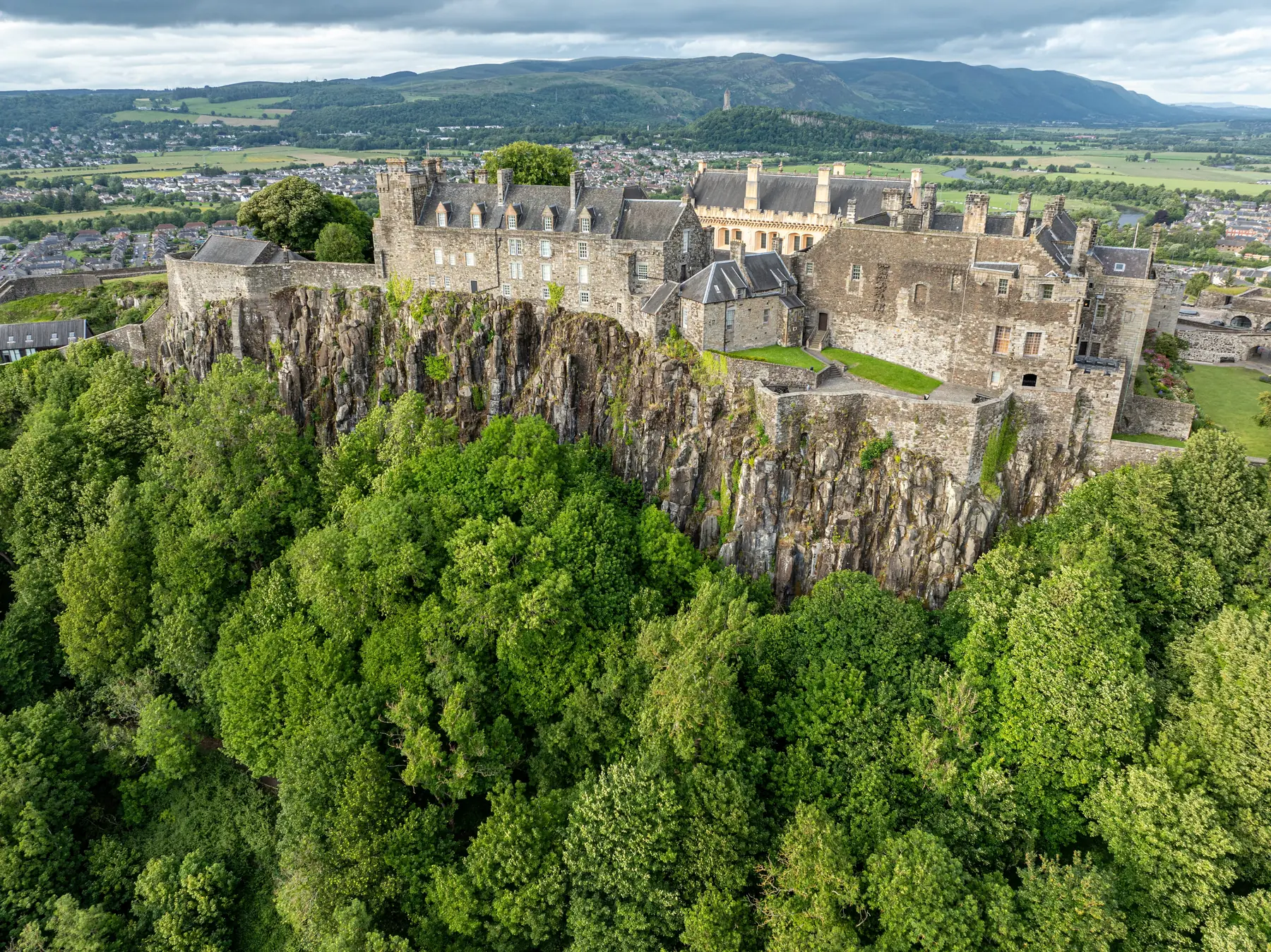
Stirling Castle stands on a volcanic crag with sheer rock on three sides and a single approachable ridge on the fourth. It is one of the largest and most important castles in Scotland, and for several centuries it was effectively the country’s capital — the Stewart kings preferred it to Edinburgh, and much of what you walk through was built to say so.
It is also the best-restored royal residence in Scotland. Where most castles are ruins to be imagined, Stirling has had its Royal Palace returned to something close to its sixteenth-century state, in colours that visitors frequently find startling.
The Forth meanders across a broad plain and, until modern engineering, Stirling was the lowest point at which it could be bridged. Everything moving between the Highlands and the Lowlands came through here. Whoever held the castle held the crossing, the tolls and the route — which is why two of Scotland’s most famous battles, Stirling Bridge in 1297 and Bannockburn in 1314, were fought within three kilometres of the walls.
“He who holds Stirling, holds Scotland” is generally attributed to Robert the Bruce, and whether or not he said it, it was true.
The centrepiece and the reason to come. James V built it in the 1540s in the newest French Renaissance style, and Historic Environment Scotland spent years restoring the royal apartments to how they would have looked when new — which means bright colour, painted ceilings, and reproductions of the Stirling Heads, the carved oak roundels of kings, queens, courtiers and classical figures that filled the King’s Presence Chamber ceiling.
The originals are displayed upstairs in the Stirling Heads Gallery, and they are extraordinary pieces of Renaissance woodcarving.
Costumed interpreters work the palace rooms in season, playing members of the sixteenth-century court, and they are among the best in Britain at it.
The largest medieval hall ever built in Scotland, completed for James IV around 1503, with a hammerbeam roof reconstructed from scratch during restoration. Its exterior is finished in royal gold limewash, which is historically correct and still causes arguments.
Rebuilt by James VI in 1594 for the baptism of his son Prince Henry, and painted with a scheme of which substantial fragments survive.
Laid out as though a Renaissance feast is in preparation, with models, food and the machinery of a royal kitchen. Children find them the best part of the castle and a good many adults agree.
Seven tapestries of The Hunt of the Unicorn were woven over fourteen years by hand at the castle, reproducing a set that once hung in the palace. The tapestry studio where they were made can be visited.
Within the castle in the King’s Old Building, covering the regiment’s history from 1794. Included in the ticket.
The Queen Anne Garden, the Douglas Gardens — where the eighth Earl of Douglas was murdered by James II in 1452 and thrown from a window — and the outer defences give views over the Forth valley, the King’s Knot below, the Wallace Monument on Abbey Craig, Bannockburn and, on a clear day, the Highlands.
Allow three hours at least; a full day is easy with the interpreters and the exhibitions.
Tickets. Historic Environment Scotland runs it, and members go free. Booking ahead is sensible in summer. The ticket includes Argyll’s Lodging in the town below at times — check when you buy.
Getting there. The castle is at the top of the old town. The walk up from the centre is steep; the Back Walk round the town wall is longer and much gentler. There is limited parking on the esplanade and it fills.
Facilities. Two cafés, a shop, and toilets.
Accessibility. The site is on a rock and the ground is uneven and steep in places, though the main buildings have level access and there is a shuttle from the esplanade at times.
Weather. The esplanade and the walls are exposed. The buildings are not — which makes this a good wet-weather visit.
The castle sits at the top of an old town full of free things. Coming down: Argyll’s Lodging, Mar’s Wark, the Church of the Holy Rude where James VI was crowned in 1567, the Old Town Jail, and the Back Walk round the sixteenth-century town wall.
Add the Smith Art Gallery, which is free, and Cambuskenneth Abbey across the river, and you have a full day without leaving the city. Our free things guide has the rest.
Early morning, as soon as it opens, is the quietest hour and the best light on the Great Hall’s gold limewash.
Midweek and out of season for the costumed interpreters without a crowd around them — they are the best thing about the castle and they work better with a small audience.
Winter is much quieter and the castle is largely indoors, which makes it a good cold-weather day out. Opening hours are shorter.
Avoid the middle of summer weekends and any day when a large event is on the esplanade, unless the event is why you came.
The Royal Palace’s restored interiors divide opinion, and it is worth knowing why before you walk in. Historic Environment Scotland chose to present the rooms as they would have looked when new in the 1540s — brilliantly coloured, gilded, hung with reproduction tapestries — rather than as weathered stone.
Some visitors find it garish. That reaction is itself informative: sixteenth-century royal interiors were meant to overwhelm, and the muted stone-coloured version of the past that most castles present is an accident of survival rather than a design choice. Stirling is one of the very few places in Britain where you can see what a Renaissance court actually looked like.
Worth knowing before you buy, because the ticket covers more than the castle rock. Argyll’s Lodging, the finest seventeenth-century townhouse in Scotland, sits on Castle Wynd just below the esplanade and is included at times — access is often by guided tour from the castle, so ask when you arrive.
The Argyll and Sutherland Highlanders Regimental Museum inside the castle is included, as is the tapestry studio where the Hunt of the Unicorn hangings were woven over fourteen years.
Historic Environment Scotland members go free, and an Explorer Pass covering multiple sites is worth considering if you are also visiting Doune, Cambuskenneth or Castle Campbell — all of which are within half an hour.
Three hours minimum; longer if you take the costumed interpretation, the tapestry studio and the regimental museum properly.
A matter of taste, but many people prefer it: it is less crowded, the Renaissance palace is more completely restored, and the setting is arguably more dramatic.
Carved oak roundels of kings, queens and courtiers that filled the ceiling of the King’s Presence Chamber. The originals are in a gallery upstairs; reproductions are back in place.
Very — the Great Kitchens, the painted palace, the battlements and the costumed interpreters all work well.
On foot from the town centre, steeply, or by the gentler Back Walk round the town wall. Parking on the esplanade is limited.