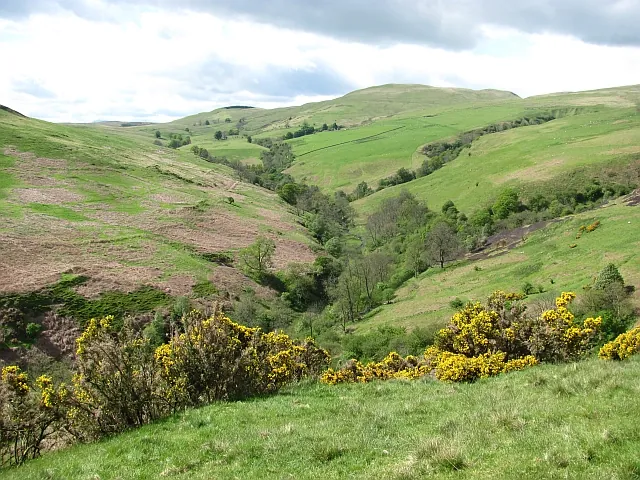
Alva Glen cuts straight into the south face of the Ochil Hills behind the village of Alva, ten kilometres east of Stirling, and it is one of the best short walks in central Scotland.
The Ochils rise abruptly from the flat carse of the Forth along a fault line, which is why they look like a wall from Stirling. The glens that cut into them — Alva, Mill, Dollar, Tillicoultry — are correspondingly steep and dramatic, and Alva is the most accessible of them.
Visitors describe it accurately as a walk in two halves.
The lower half runs through woodland along the burn on a made path, with bridges, waterfalls and pools. It is easy going, well surfaced, and suitable for most people. This alone is a pleasant half-hour.
The upper half climbs. The path leaves the trees and rises steeply into the gorge proper, with the Smuggler’s Cave, the Silver Glen branch and a series of falls, on ground that is rougher and considerably harder work. It reaches, at its most demanding, what walkers describe as a reasonably moderate level — steep and sustained rather than technical.
There is one point on the upper route involving a short climb down with a drop or jump of a couple of feet, which is worth knowing about in advance.
Beyond the glen head, paths continue onto the open Ochils and up Ben Cleuch (721 m), the highest of them — a proper hill day of four to five hours from the village.
So the glen serves everything from a twenty-minute stroll to a full hill walk, which is why local walkers rate it so highly.
The Ochils above Alva were mined for silver in the early eighteenth century — the Silver Glen produced genuinely rich ore for a short period, along with cobalt and nickel, and the workings brought a brief and chaotic rush to the village.
The Smuggler’s Cave in the glen is associated with illicit whisky distilling, which was widespread in these hills when duty was high and the glens were unwatched.
The village below was a woollen mill town — the Hillfoots villages along the Ochil fault all were, using the burns for power — and the glen’s paths and bridges were largely laid out in the nineteenth century as a public amenity for the mill workers.
Free, open at all times.
Parking: free car park at the glen entrance in Alva.
Time: thirty minutes for the lower woodland; ninety minutes to two hours for the full glen; half a day onto the hills.
Facilities: toilets at the car park; Alva village has shops and a café.
Access: the lower woodland path is manageable for many; the upper glen is not accessible.
Footwear: boots or good shoes for anything above the woodland. The rock is wet and slippery year-round.
Safety: there are drops beside the path in the upper glen, and the burn is fast after rain. Keep children close.
Best after rain, when the falls are running.
The other Hillfoots glens — Mill Glen at Tillicoultry and Dollar Glen with Castle Campbell above it, both a few minutes east and both excellent. Dollar Glen and its castle are National Trust for Scotland.
Ben Cleuch and the Ochil ridge above.
Stirling is twenty minutes west.
The lower woodland section is easy and well surfaced. The upper glen climbs steeply and is moderate walking, with one short drop-down of a couple of feet.
Yes, free with a free car park at the entrance in Alva.
Thirty minutes for the woodland, ninety minutes to two hours for the full glen, half a day if you continue onto the Ochils.
Yes — paths continue from the glen head onto the open Ochils and up Ben Cleuch, the highest of them at 721 metres.
A cave in the upper glen associated with illicit whisky distilling, from a period when the Ochil glens were beyond effective supervision.