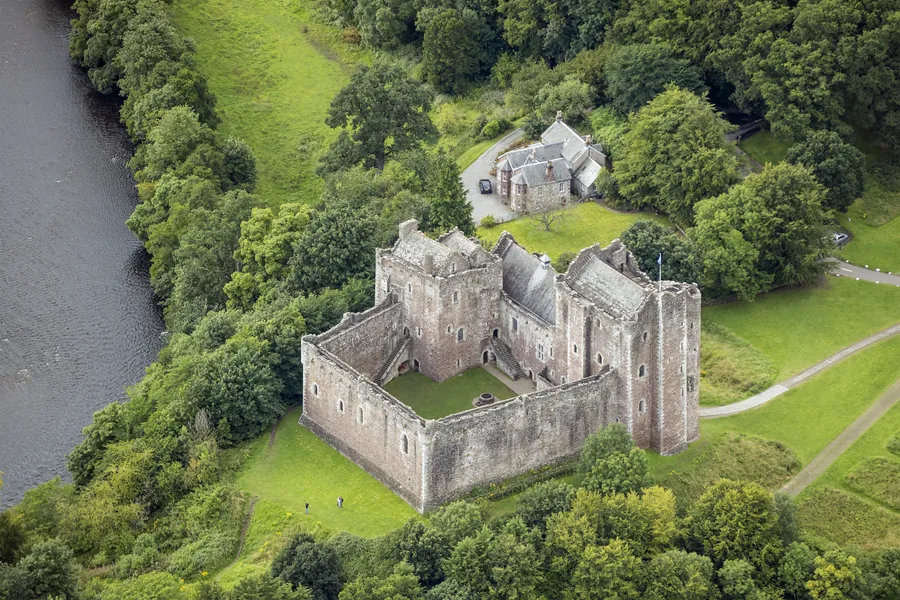
Doune Castle stands on a wooded bend where the Ardoch Burn meets the River Teith, near the village of Doune, thirteen kilometres north-west of Stirling.
It was built in the late fourteenth century for Robert Stewart, Duke of Albany — son of Robert II, and for a long period the effective ruler of Scotland as regent for his brother and then his nephew. It is one of the best-preserved medieval tower houses in Scotland, and it was never substantially altered afterwards.
Doune is unusual because it is essentially a single great block rather than a courtyard of ranges: a massive gatehouse tower containing the lord’s own apartments, joined to a Great Hall and kitchen tower, with a curtain wall enclosing a courtyard that was never fully built up.
That makes it exceptionally easy to read. You can see the whole arrangement of a great lord’s household in one building: the Lord’s Hall with its double fireplace, the Great Hall with its restored open timber roof and musicians’ gallery, the enormous kitchen with a fireplace you could park a car in, the cellars, and the private chambers above.
The wall walk gives views over the Teith and the countryside towards the Trossachs.
Doune has been used so often on screen that a substantial proportion of its visitors arrive without knowing anything about Robert Stewart.
Monty Python and the Holy Grail (1975) used Doune for almost every castle in the film — Camelot, Swamp Castle, the Castle Anthrax, and the castle whose French occupants were rude about hamsters and elderberries. Almost all the castle interiors and exteriors are here.
Outlander uses it as Castle Leoch.
Game of Thrones used it as Winterfell in the pilot episode.
Ivanhoe and others have filmed here too.
It is included, and it is the best in Scotland.
There are two: one narrated by Terry Jones of Monty Python, covering both the real history and the filming, and one by Sam Heughan of Outlander.
Jones’s is the one to take even if you have never seen the film — he was a serious medieval historian as well as a comedian, and the guide is genuinely informative as well as funny. Visitors consistently name it as the highlight, which is a rare thing to say about an audio guide.
It is small. One tower and a hall, and you can see it in an hour to ninety minutes. Visitors regularly describe it as small but well worth it, and both halves of that are true.
The riverside trail behind the castle runs along the Teith through woodland and is a pleasant half-hour, with good views back to the castle.
Staff are consistently described as helpful and welcoming.
Admission charged by Historic Environment Scotland; free to members and to English Heritage members after a qualifying period. Book online — it is popular and slots sell out.
Time: an hour to ninety minutes, plus the trail.
Facilities: shop, toilets. No café on site; Doune village is five minutes away and the Deanston Distillery is close by.
Access: the ground floor and courtyard are largely accessible; the upper floors and wall walk are spiral stairs only.
Parking: free on site.
Getting there: Castle Hill, Doune, about twenty minutes from Stirling by road, with buses from Stirling and Callander.
Yes — almost every castle in Monty Python and the Holy Grail was filmed here, inside and out.
Outlander uses it as Castle Leoch and Game of Thrones used it as Winterfell in the pilot.
Yes — it is included, and the Terry Jones version is widely rated as the best audio guide in Scotland.
An hour to ninety minutes for the castle, plus half an hour for the riverside trail.
Yes, booking online is advisable — it is popular and slots sell out.