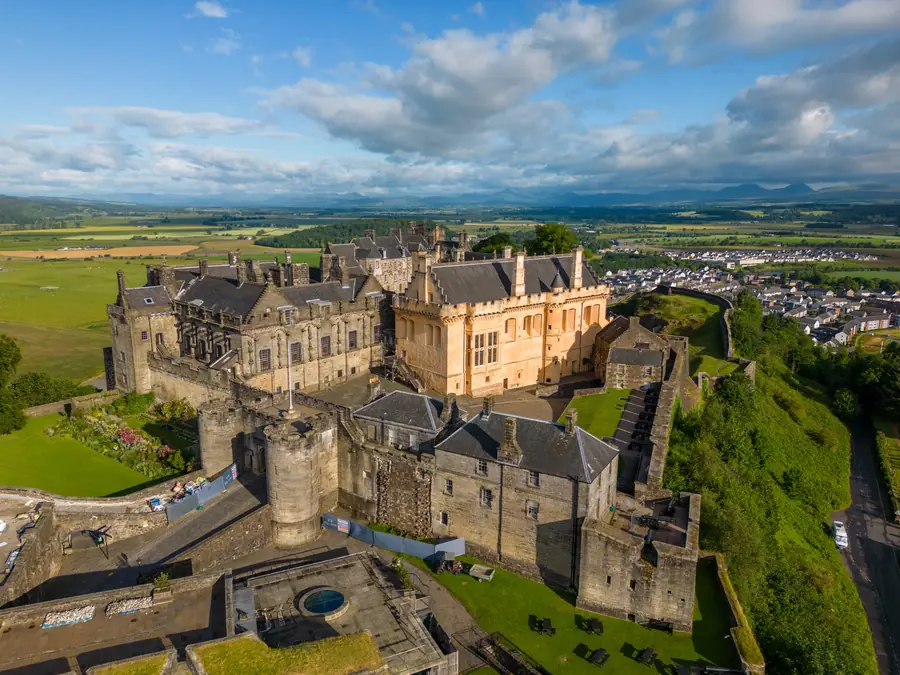
Stirling Castle sits on an intrusive crag — part of the Stirling Sill, a volcanic intrusion — with cliffs on three sides, and it is one of the largest and most important castles in Scotland.
Its position explains everything. It guarded what was, until the 1890s, the furthest downstream crossing of the River Forth. Everything moving between the Lowlands and the Highlands had to pass beneath it. Whoever held Stirling held Scotland, and the phrase “the brooch that clasps the Highlands and Lowlands together” is not a tourist-board invention.
The outstanding thing at Stirling is the Royal Palace of James V, built in the 1540s and one of the finest Renaissance buildings in Britain.
It has been restored to how it would have looked in about 1550 — not preserved as a ruin but returned to full colour, and the effect is startling. Walls in scarlet and gold, painted ceilings, oak panelling, and reproduction furnishings.
The Stirling Heads — carved oak roundels, over a metre across, that filled the ceiling of the King’s Presence Chamber with portraits of kings, queens, courtiers and classical figures. The originals are in a gallery; the ceiling has been recreated with brightly painted replicas.
The Hunt of the Unicorn tapestries — seven enormous tapestries hand-woven over thirteen years by weavers working on site, reproducing a famous set now in New York, and hung in the Queen’s apartments. The weaving project ran from 2001 to 2014 and is one of the most ambitious craft undertakings in modern Britain.
The Great Hall of James IV, completed around 1503 — the largest medieval hall ever built in Scotland, restored in the 1990s and harled in golden ochre, which caused enormous controversy and is historically correct.
The Chapel Royal, rebuilt by James VI in 1594 for the baptism of his son, with a painted frieze.
The Great Kitchens, laid out as they would have been for a Renaissance banquet.
The Regimental Museum of the Argyll and Sutherland Highlanders.
The Queen Anne Garden and the ramparts, with views over the Forth valley, the Wallace Monument, the Ochils and the field of Bannockburn.
Mary Queen of Scots was crowned here in 1543, aged nine months, and lived here as a child. On the battlements, visitors point out initials carved in the stone.
These are the best thing about a visit and they are included.
They run every thirty minutes from 10am to 4pm, last about forty-five minutes, and are given by guides who are consistently described as excellent — informative, funny and unhurried.
Take one first, then go round again with the audio guide for the detail. Visitors who do it in that order report much the better visit.
Live performances and costumed interpreters work the palace through the day.
Parking at Stirling Castle is difficult and often unavailable. The castle car park is small, hard to reach through the old town’s narrow streets, and is frequently closed to cars.
Use the Park and Ride. Stirling’s park and ride runs a bus service directly to the castle, and visitors who use it describe it as seamless while those who drove describe chaos. This is the clearest practical advice about visiting Stirling.
Admission charged by Historic Environment Scotland; free to members and Explorer Pass holders. Book online.
Time: three to four hours.
Facilities: two cafés, shops, toilets.
Access: much of the castle is accessible with lifts and ramps; some areas involve stairs.
Getting there: at the top of the old town, ten minutes’ steep walk from Stirling station, or by park and ride bus.
Yes, included in admission, every thirty minutes from 10am to 4pm, and they are the best part of a visit.
Seven tapestries hand-woven on site over thirteen years, reproducing a famous medieval set, hung in the Queen’s apartments.
No. Castle parking is limited and often closed; use Stirling’s park and ride, which runs a bus to the castle.
Three to four hours.
James V’s Renaissance palace of the 1540s, returned to its approximate 1550 appearance in full colour, with painted ceilings and the recreated Stirling Heads.