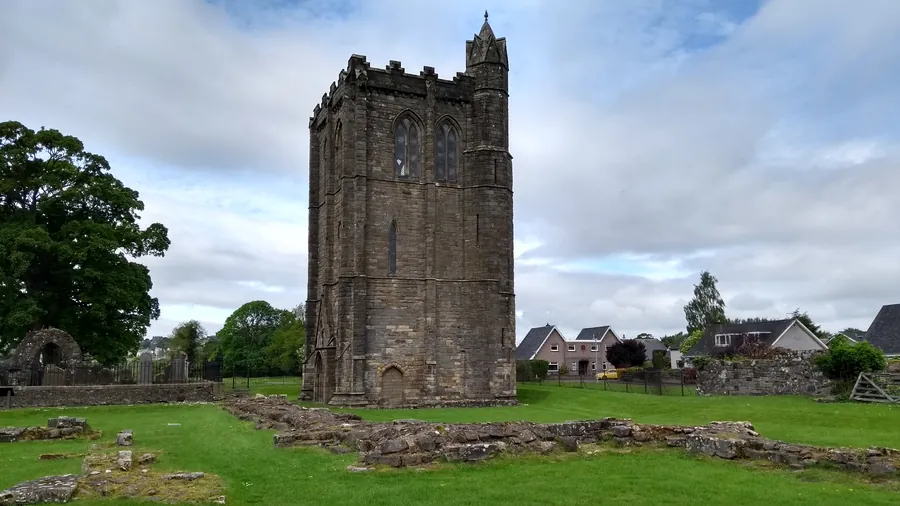
Cambuskenneth Abbey — properly the Abbey of St Mary of Cambuskenneth — stands on flat ground inside a great meander of the River Forth, about a kilometre and a half east of Stirling, with the castle on its crag in one direction and the Wallace Monument on its hill in the other.
It was founded around 1140 by David I for Augustinian canons, and it was one of the wealthiest and most important religious houses in Scotland.
It is free.
Mostly foundations — the plan of the church and the claustral buildings laid out at ground level in mown grass, which makes the layout unusually easy to read.
And, standing complete, the bell tower: a free-standing thirteenth-century campanile, three storeys, with a vaulted ground floor. Detached bell towers are rare in Britain — this is the only substantially complete example in Scotland — and it is a striking thing to come upon in a field.
The tower can sometimes be entered; access is seasonal and limited.
James III was killed in 1488 after the Battle of Sauchieburn, fought a short distance south — a rebellion led, nominally, by his own fifteen-year-old son, who became James IV and wore an iron chain round his waist for the rest of his life in penance.
James III was buried at Cambuskenneth beside his queen, Margaret of Denmark, who had died two years earlier.
The graves were lost when the abbey was destroyed, and were rediscovered in 1864. Queen Victoria paid for the present monument over them, which stands on the site of the high altar.
Robert the Bruce held a parliament here in 1326 — the one at which the succession was settled and the Scottish estates formally granted taxation, an important moment in the development of the Scottish parliament.
The abbey was also a place of education, and there is a tradition connecting William Wallace with it in his early life, though the evidence is thin.
It was destroyed at the Reformation in 1559 and its stone was carted off to build in Stirling — including, reportedly, to the castle.
The best way to arrive is on foot from Stirling, along the Forth.
A footbridge crosses the river to Cambuskenneth village, and the walk from the town takes about twenty to thirty minutes through the riverside meadows. It is level, quiet, and gives the classic view of the abbey tower against the castle crag.
The village itself is a handful of houses inside the river loop — one of the more surprising pieces of geography near a Scottish city.
Free, in the care of Historic Environment Scotland.
Time: twenty to thirty minutes on site.
Season: the grounds are generally open; access to the tower interior is seasonal and limited — check before travelling if that is the point of the visit.
Facilities: none. Stirling is twenty minutes’ walk.
Access: the grounds are level mown grass and are largely manageable; the tower has stairs.
Parking: very limited in Cambuskenneth village — the streets are narrow and residential. Walking from Stirling is much the better plan.
Yes, free and in the care of Historic Environment Scotland.
The foundations of the church and cloister, laid out in grass, and a complete free-standing thirteenth-century bell tower — the only substantial one of its kind in Scotland.
James III, killed in 1488 after Sauchieburn, and his queen Margaret of Denmark. Queen Victoria paid for the monument over their rediscovered graves.
Sometimes — access is seasonal and limited. Check before travelling.
Walk from Stirling along the Forth and across the footbridge, about twenty to thirty minutes. Parking in the village is very limited.