The David Stirling Memorial stands on high ground beside the road at Hill of Row, near Doune and Dunblane, about eight kilometres north-west of Stirling.
It is a bronze statue of a man in desert uniform on a rough stone plinth, in an open field with wheat and grass around it and the Trossachs and the Forth valley in the distance.
It commemorates Sir David Stirling (1915–1990), founder of the Special Air Service.
Stirling was born at Keir, a few miles from where the memorial stands, into a Perthshire landed family.
In 1941, aged twenty-five and a subaltern in the Scots Guards attached to the Commandos, he proposed a new kind of unit for the North African campaign: small parties operating far behind enemy lines, inserted by parachute or by vehicle, attacking airfields and supply lines rather than fighting in the line.
The idea was rejected through official channels, so he got into Middle East Headquarters in Cairo on crutches — he was recovering from a parachuting injury — talked his way past the sentries, and put the plan directly to the Deputy Chief of Staff. He was given permission to raise a detachment of sixty men.
Over the following eighteen months the unit destroyed several hundred enemy aircraft on the ground and did damage out of all proportion to its size. Rommel called Stirling “the Phantom Major”.
He was captured in 1943, escaped four times, and was eventually sent to Colditz. His later career, including work in Africa and in private security, was more controversial, and the memorial does not attempt to cover it.
The memorial stands where it does because the country around here — the Stirlingshire and Perthshire hills — is where the SAS trained and where Stirling grew up.
The statue, by Angela Conner, was unveiled in 2002. It shows Stirling standing, looking out over the ground, and the effect of a single figure alone in a field with a long view is considerably stronger than a memorial in a town square would be.
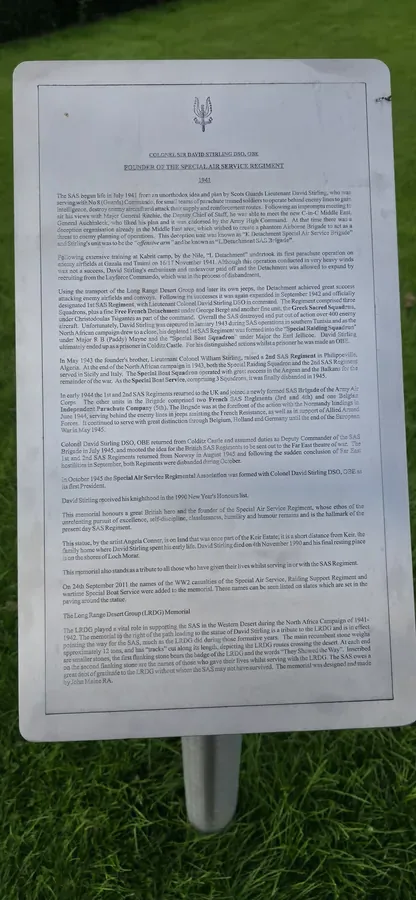
Display boards around the site tell the story of the man, the regiment’s formation and its wartime operations. Visitors consistently describe them as well written and interesting, which is not always true of memorial interpretation.
The site is very well kept, and that too is repeatedly mentioned.
It is a roadside memorial, not an attraction. There is a small parking area, a short path, the statue and the boards.
Twenty minutes covers it, and it is worth those twenty minutes if you are passing between Stirling and Doune or Callander.
The setting is the thing. On a clear day, standing at the memorial with the fields running away and the hills beyond, it does what a memorial should.
Free, open at all times.
Time: fifteen to twenty minutes.
Parking: a small free layby and parking area at the site.
Facilities: none.
Access: a short path from the parking area over grass; broadly manageable.
Exposure: it is an open hilltop. There is no shelter.
Doune Castle is five minutes away.
Blair Drummond Safari Park is ten minutes.
Dunblane, with its magnificent thirteenth-century cathedral — free, and one of the finest medieval churches in Scotland — is ten minutes north-east.
Stirling is fifteen minutes south-east.
The founder of the Special Air Service, who proposed and raised the unit in 1941 during the North African campaign. He was born nearby at Keir.
Because the surrounding country is where he grew up and where the SAS trained, and the open setting is deliberate.
Yes, free and open at all times, with a small free parking area.
Fifteen to twenty minutes.
Doune Castle five minutes away, Blair Drummond Safari Park ten minutes, and Dunblane Cathedral ten minutes north-east.