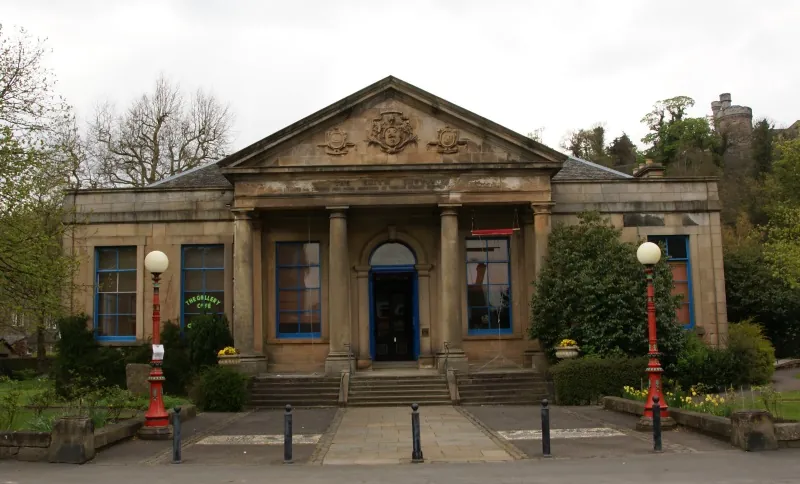
The Stirling Smith Art Gallery and Museum stands on Albert Place beside King’s Park, five minutes from the town centre, and it is free.
It was founded in 1874 under the will of Thomas Stuart Smith, an artist who left his collection and his money to build a museum for Stirling. He died in 1869 without seeing it open.
It is a local history museum and art gallery in one building, and its character is best described as eclectic — which is exactly what visitors call it, and which is the point.
The Smith’s most famous object is a leather ball found in the rafters of the Queen’s Chamber at Stirling Castle during renovation work.
It dates from around 1540, which makes it the oldest football in the world. It is a pig’s bladder inside a hand-stitched leather casing, and it is small, misshapen and unmistakably a football.
It was almost certainly played with at the court of Mary of Guise, and it very probably ended up in the roof because somebody kicked it there.
The Smith also holds the world’s oldest curling stone, dated 1511, from Stirling — so between them the two objects give the town a fair claim to a good deal of sporting history.
Local history, arranged thematically and covering Stirling from prehistory to the present: the burgh, the battles, the trades, the Forth crossings and industry.
Art — the Smith’s own paintings, Scottish nineteenth- and twentieth-century work, and a changing exhibition programme.
Tunnock’s teacake sculptures — the museum has become known for artworks celebrating the Uddingston biscuit, which is exactly the sort of thing a good local museum should do and which visitors mention with delight.
Wallace and Bruce material, and objects connected to the town’s central role in Scottish history.
Local curiosities of every description, which is where the eclecticism comes in.
The consistent report is surprise: people expecting a small municipal collection find something more interesting, well displayed and thoughtfully organised.
They also report it being quiet — even on a Saturday — which given it is free, central and good, is slightly baffling and entirely to the visitor’s advantage.
There is a basket of chalk outside for children to draw on the pavement, which tells you something about how the place is run.
Time: an hour to ninety minutes.
Free, donations welcome.
Time: an hour to ninety minutes.
Location: 40 Albert Place, beside King’s Park, five minutes’ walk from the town centre.
Facilities: café — well liked — shop, toilets.
Parking: free parking nearby, which visitors specifically mention as a rarity in Stirling.
Access: largely accessible on the ground level; check for the upper gallery.
Opening: typically closed on Mondays; check before travelling.
King’s Park is immediately alongside — the town’s main park, free, with a skate park, tennis courts and open grass.
Stirling Castle is fifteen minutes uphill.
The Old Town and the Church of the Holy Rude are between the two.
Stirling station is ten minutes east.
Yes, free entry with donations welcome.
A leather ball of about 1540, found in the rafters of the Queen’s Chamber at Stirling Castle — the oldest football in the world. The museum also holds the oldest curling stone, dated 1511.
An hour to ninety minutes.
Yes, free parking nearby, which is unusual in Stirling.
Artworks celebrating Tunnock’s teacakes, which have become one of the museum’s better-known holdings.