King’s Park lies immediately south-west of Stirling town centre, below the castle rock, and it is the town’s principal public open space.
The name is not decorative. This was the royal hunting park of the Stewart kings, attached to Stirling Castle, and parts of it — including the King’s Knot, the extraordinary stepped earthwork below the castle — are surviving elements of the royal landscape.
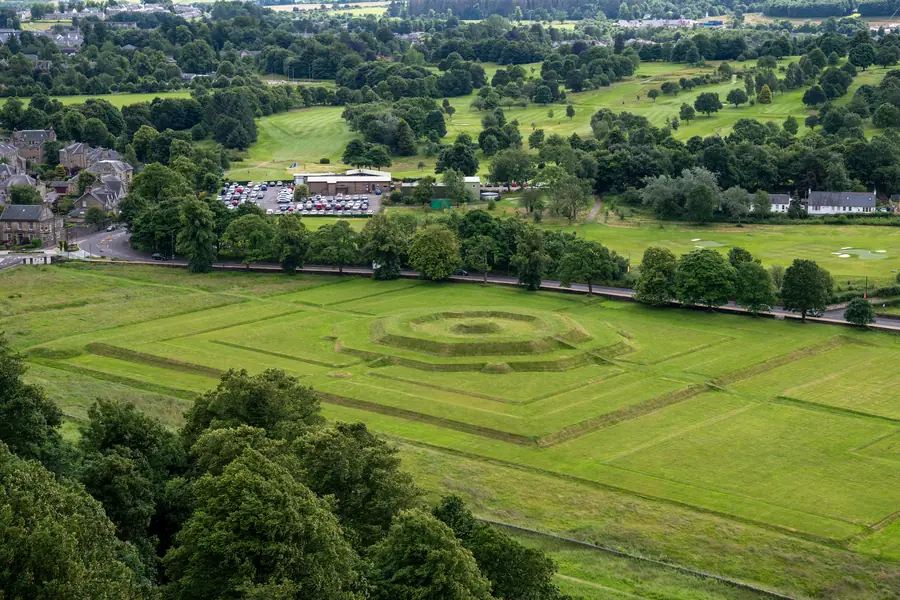
Visible from the castle ramparts and walkable at ground level, the King’s Knot is a large geometric earthwork of terraces and mounds in the flat ground below the crag.
It was formed in 1628 as an ornamental garden for Charles I, on the site of earlier royal gardens, and its stepped octagonal mound and surrounding platforms are one of the best-preserved seventeenth-century formal garden earthworks in Britain.
Geophysical survey has found earlier features beneath it, and there are long-standing and unproven traditions connecting the site with a round table and with Arthurian legend, recorded as early as the fourteenth century.
It is free and open, and the view from the castle above is what makes the pattern legible.
A skate park — modern, well built and heavily used, and specifically praised by the people who skate it.
Swings and play equipment, well regarded.
Tennis courts.
A golf course — King’s Park Golf Club, a public course on part of the old royal park.
Open grass, mature trees and walks.
Public toilets which have prompted genuinely enthusiastic reviews — hot water, soap and working hand dryers, immaculately kept. That sounds like faint praise and is not: in a public park in 2026 it is close to remarkable, and it is an accurate index of how the whole park is maintained.
Visitors also note the complete absence of litter, which is the other reliable sign of a well-run park.
King’s Park is a residents’ park rather than a visitor attraction, and that is its appeal. It is five minutes from the town centre and a world away from the castle queues.
The Stirling Smith Art Gallery & Museum is on the park’s edge, is free, and has a café — the natural pairing.
The castle is a fifteen-minute uphill walk.
Free, open at all times.
Location: Albert Place, five minutes’ walk south-west of the town centre.
Parking: free parking nearby, which in central Stirling is worth knowing.
Facilities: toilets opposite the tennis courts; the Smith’s café is on the edge of the park.
Access: largely level with surfaced paths.
Dogs: welcome.
The Stirling Smith Art Gallery & Museum, free, on Albert Place.
The King’s Knot, free and open, below the castle crag.
Stirling Castle, fifteen minutes uphill through the old town.
The Back Walk, a path following the line of the town’s medieval walls round the castle rock — one of the best short walks in any Scottish town, and free.
Gowan Hill, north of the castle, with the Beheading Stone and views over the Forth.
Yes, free and open at all times, with free parking nearby.
A large stepped garden earthwork formed in 1628 for Charles I on the site of earlier royal gardens, below the castle. It is free to walk to.
Yes, and it is modern, well built and well regarded by the people who use it.
Opposite the tennis courts, and they are unusually well maintained.
The Stirling Smith museum and café on the park’s edge, the King’s Knot below the castle, and the Back Walk round the castle rock.