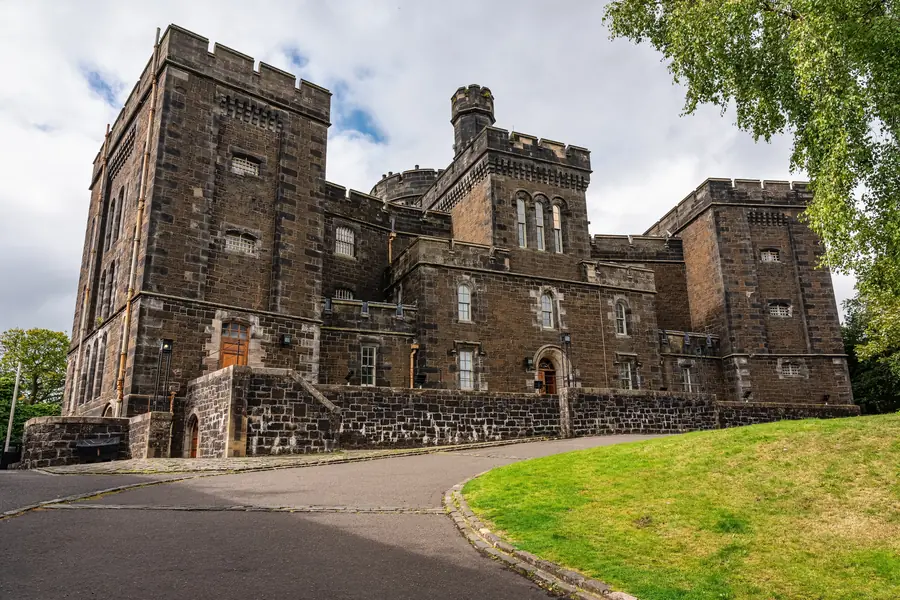
Stirling Old Town Jail sits on St John Street, FK8 1EA, halfway up the old town between the shops and the castle. It is next to the SYHA hostel and opposite the Tolbooth. You pass it if you walk up to the rock; the park-and-ride bus drops you at the door. It is not a Historic Environment Scotland site, it is not in the castle ticket, and it is not a museum with labels. It is an independent attraction in a real Victorian prison, run as theatre.
That last point is the one to get straight before you buy. People walk up from the castle assuming the same organisation, the same ticket, the same tone. None of those things are true.
The jail is the pause on the climb. From the town centre it is a steep ten minutes; from the castle esplanade it is a short walk down Castle Wynd and St John Street. The old-town piece covers the street. This page is the building.
The Gate House at the entrance has, in recent seasons, also been the place to pick up city information and the Stirling City Pass. Treat that as an operator arrangement; tourist-office hours are not tour hours. You do not need to go in to use the street. You do need to go in if you want the cells, the performance and the tower.
The building opened in 1847 as Stirling’s New County Jail, and it was the last Reformed prison built in Victorian Scotland. It replaced the Tolbooth across the road, which a prison inspector had already described as among the worst in Britain — overcrowded, filthy, and effectively ungoverned.
The new jail was designed on the separate system: one prisoner, one cell, silence, labour, religious instruction. The theory was that solitude would reform. It served as a civil prison until 1888, then as a military detention barracks until 1935. Later parts of the building became offices, which matters when you walk through, because you are not seeing every wing. The tour is about that reform as much as it is about individual inmates.
This is not a walk with a headset and a volunteer. Costumed performers take groups through in character — a warder, a prisoner, sometimes more than one in the same hour — and the show is the reason the place has the reputation it has.
Tours leave every 30 minutes from 10.15am, with the last at 5.15pm, as of the operator’s tours page. The building has been advertised open daily, 10am–6pm. Those figures sit on oldtownjail.co.uk and they move; check the booking page the morning you go, especially in winter.
The live section is the shorter half. After it, you are turned loose on the cells, the exercise yard and the observation tower with an audio handset or the app. Most people take 45 to 90 minutes for the whole visit. You can linger. You cannot rewind the actor.
There is a relaxed, self-guided slot in the early afternoon — lights and sound turned down — which is the right product if a performance is the wrong one. Book that if you need it. Photographs during the performance have been allowed; that is an operator courtesy, not a right.
The cells are real. They are not a reconstruction bolted onto a visitor centre. You go in. The scale is the shock: Victorian reform still meant a stone box. The exercise yard is on the roof, which children understand immediately. From there you go on up to the observation tower.
The tower is the other half of the ticket: a 360-degree view over the old-town roofs to Stirling Castle, the Wallace Monument on Abbey Craig, the Ochils and the Forth valley. On a clear day the operator talks about the Forth bridges. On an ordinary day you still see why the town was built on this rock.
The rooftop is stairs. The ground floor is the accessible part, with an accessible toilet. If stairs are the problem, the performance and the cells can still be a visit; the view cannot. Ask on booking rather than at the foot of the spiral.
One honest limit: you do not see the whole building. Later conversion to offices took wings out of the tour. Judge it as an hour of theatre in a genuine cell block, plus a tower, not as a comprehensive prison museum. On those terms it is very good.
A Historic Environment Scotland ticket for Stirling Castle does not include the jail. Members’ cards do not cover it. Explorer Passes do not cover it. It is a private operator on a different building, with a different till.
The product that does bundle them is the Stirling City Pass, which in recent seasons has combined the castle, the jail and the Wallace Monument (and sometimes the Holy Rude and a walking tour). Buy it if you are doing all three; check the pass page for what is actually in the bundle the week you travel. Do not assume the Gate House can add a castle entry to a jail ticket after the fact.
Argyll’s Lodging, the seventeenth-century townhouse on Castle Wynd that older guides still send you into after the jail, has been closed for essential maintenance until further notice as of August 2026. Look at the outside. Do not build a morning around the interior.
The operator’s own line is the right one: child-friendly, “not too scary”, and tell them if you are nervous. It is a prison tour played as history and character rather than as a fright. Very young children may find the tone more than the content; the operator would rather know in advance.
Well-behaved dogs are welcome, including on the performance tours, which is unusual for an indoor attraction on this hill. The castle, by contrast, is assistance dogs only. Escape rooms run as a separate product in the same building. They are not the tour.
The jail has free on-site parking for visitors — worth reading twice in a town where the castle esplanade is restricted. The gates close at 6pm in summer and 5pm the rest of the year. If you are booked late, ring ahead rather than rattling the gate. Do not leave the car in the yard and walk to the Wallace Monument, and do not use it as a free castle car park.
The P2 park-and-ride bus from Castleview alights here. See parking in Stirling. From the station it is a steep walk up; our getting here page has the trains.
The jail is the stop between the shops and the esplanade. The shape that works: castle first, while the legs are fresh, then down Castle Wynd past Mar’s Wark and the Holy Rude to the jail for the afternoon performance. Lunch on the way down. Our castle guide is the morning; this is the next hour.
Or reverse it on a late start: jail at 10.15, then up to the castle. You will climb after the tower stairs. The old town is the street that connects them. The Back Walk is the gentler way round the crag. The Smith, down by King’s Park, is the indoor hour if it is open — Wednesday to Sunday as of its own site, not Monday and Tuesday. A wet day strengthens the jail: the performance is indoors, the tower can wait. See Stirling in the rain.
As of the operator’s tours page, performance tours have been £15 adult, £13.50 concession, £9 for children 5–16, with a cheaper self-guided audio tariff under that. Check the booking page. Those numbers move.
Book a time. Walk-up is possible and not a right; fourteen slots a day still fill in the school holidays. Winter can thin the timetable. The “open daily 10–6” line is the main-season claim. Do not build a December morning around a door that has gone over to escape rooms.
The jail is the independent hour on the hill. The castle is the state rooms. Do both. Pay twice, or buy the pass that is actually selling both. Then walk down.